With over 10,000 orders
Skip to content
Hose clamps are ring-shaped clamps used to attach and seal a hose onto a fitting, barb, or pipe nipple. By tightening a hose clamp around a hose’s end, you create a secure seal that prevents the hose from sliding off and stops fluid or air leaks. In other words, a hose clamp keeps your connection tight and leak-proof – essential for maintaining anything from car coolant hoses to home plumbing lines. These handy devices are found in many DIY and professional applications. For example, mechanics use hose clamps on fuel lines, coolant hoses, and even the air intake hose clamp on engines, while plumbers use them on washing machine hoses or garden hoses to stop leaks. Whether you’re into automotive repairs, marine maintenance, or general home fix-it projects, you’ll likely need a few trusty hose clamps in your toolbox – they’re inexpensive, easy to use, and can save the day when you need a quick and reliable hose connection fix. (Need a variety of hose clamps for your projects? Ouru’s got you covered with an assorted kit – Shop Now.)
There are many types of hose clamps, each suited for certain uses. Common types of hose clamps include worm gear clamps, spring clamps, ear clamps, and T-bolt clamps, among others. Worm gear clamps (the familiar adjustable band clamps) are the most widely used style – you tighten them with a screw, and they work for a range of hose sizes. Spring clamps (a.k.a. spring tension or constant-tension clamps) are made of spring steel and automatically adjust tension as the hose expands or contracts with temperature changes. Ear clamps (sometimes called Oetiker clamps or pinch clamps) are crimped in place for a permanent seal, often used on fuel lines or air hoses where a tamper-proof fix is needed. And for high-pressure or large-diameter hoses, you have T-bolt hose clamps – heavy-duty clamps tightened with a bolt and nut, providing a very strong, uniform clamping force. We’ll explore the worm gear and spring types in detail in the next sections, since they are especially common for DIYers, but we’ll also touch on the others so you know when you might need them. (Tip: For most home and automotive tasks, a simple kit of adjustable stainless steel worm clamps will handle hoses of various sizes – check out Ouru’s all-in-one hose clamp kit and be prepared for any leak Shop Now.)
Note: Don’t confuse sealing hose clamps with pipe support clamps. In plumbing and hardware catalogs, terms like “hose pipe clamps,” “1 inch pipe clamp,” “pipe riser clamp,” or “insulated pipe clamps” usually refer to brackets or hangers that support a pipe or hose run – not clamps for sealing a hose connection. Many hydraulic line clamps, for instance, are cushioned supports to reduce vibration, and not meant to stop flow. (There are even “pinch-off” line clamps used as temporary shut-off tools.) In this article, we’re talking about clamps used to seal hoses onto fittings and stop leaks. So when we say hose clamp, we mean a clamp for tubing that seals a joint rather than just holding a pipe in place. Knowing the difference helps you get the right part for the job. (If you’re shopping for sealing clamps, double-check that the product is meant for sealing. Ouru’s hose clamps are true sealing clamps designed to tighten hoses onto barbed fittings – perfect for DIY fixes. Shop Now to get the right ones.)
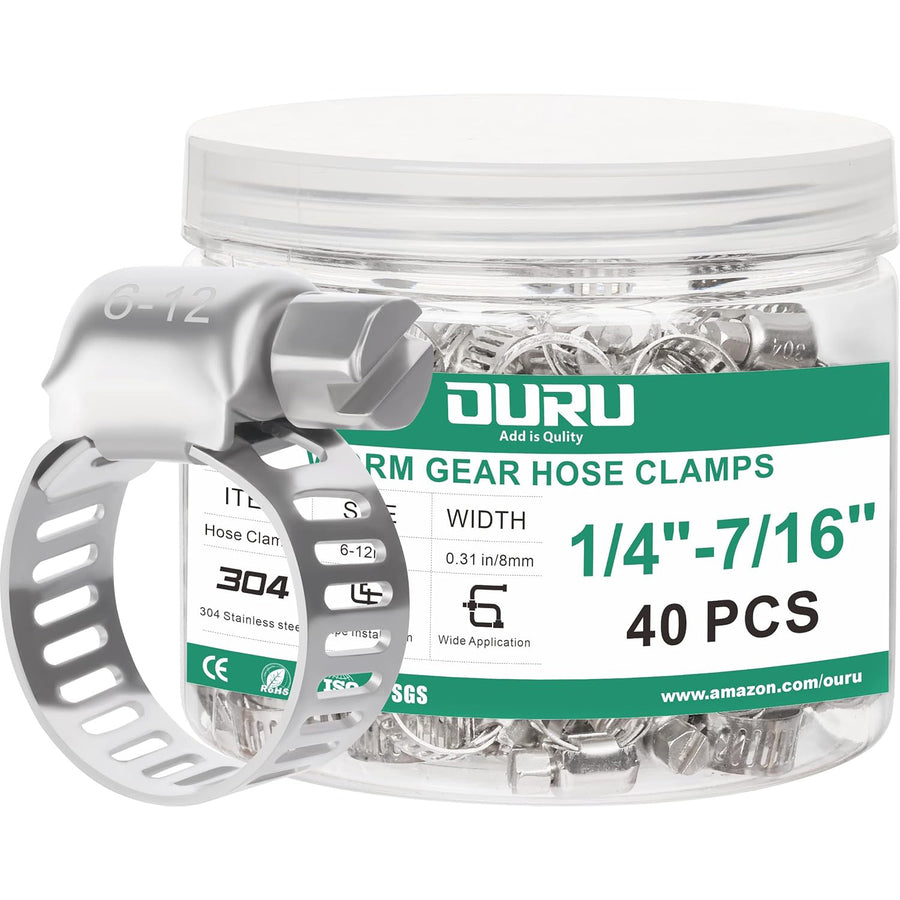
When you picture a typical hose clamp, you’re probably thinking of a worm gear clamp. This is the most common type of hose clamp by far, used in automotive, plumbing, and general hardware applications. Worm gear hose clamps consist of a band (usually stainless steel) with slots cut into it, and a captive screw (the “worm” drive) housed in a small mechanism on the band. As you turn the screw, it engages the slots and tightens or loosens the band’s diameter around the hose. This simple design makes worm clamps adjustable to fit a range of hose sizes, and they’re reusable – you can loosen the clamp and remove or reposition it whenever needed. For DIY folks, worm gear clamps are the go-to because you only need a flat-head screwdriver or nut driver to tighten them, and they provide a reliable 360° seal on the hose. In fact, worm clamps are ideal in situations where you might need to remove the hose occasionally (for cleaning or replacement), since the screw mechanism makes them easy to undo and retighten. They’re truly the “universal” hose clamp for most low to medium pressure applications. (Ouru’s hose clamp kits feature high-quality stainless steel worm gear clamps, covering multiple diameters so you’ll always have the right fit on hand. If you’re tackling various projects, grab a kit and save yourself extra trips to the store – Shop Now.)
Worm gear clamps come in many sizes to suit different hoses. At the small end, you can get miniature worm clamps (sometimes labeled as mini hose clamps or by SAE size, e.g. a #4 hose clamp or #6 hose clamp) for hoses under 1/2 inch in diameter – think small fuel lines or vacuum tubing. At the large end, standard worm gear clamps can be made to fit big hoses of several inches across. For example, a 2 inch hose clamp or 3 inch hose clamp would be common for radiator hoses or intake pipes, and you can even find 4 inch hose clamps or larger for things like home HVAC ducts or dust collection pipes. There are worm gear clamps advertised up to 6 inch hose clamp and beyond. However, when hose diameters get very large (or pressures very high), a single worm gear clamp may not always hold perfect tension. In critical cases – say a large industrial hose or marine exhaust line – you might see two hose clamps side by side for extra security, or a switch to the heavy-duty T-bolt style (more on that soon). The good news is that for most DIY uses, a properly sized worm clamp will do the job. Just be sure to choose a clamp that fits your hose’s diameter range (you want your hose size to fall roughly in the middle of the clamp’s stated min-to-max range for best results). Worm clamps are often sold in assorted packs listing their size ranges in inches or millimeters (e.g. 1/2″–3/4″, 3/4″–1-1/8″, etc.), so it’s easy to pick one that fits your hose. (By getting a hose clamp kit with multiple sizes, you’ll have everything from 1 inch hose clamps for small pipes up to 3″ hose clamps for larger tubing in one convenient box. Check out Ouru’s kit – it’s a cost-effective way to stock up on all common sizes. Shop Now and be ready for any project.)
One reason worm gear clamps are so popular is that they are typically made of metal (often stainless steel) which gives them strength and durability. You’ll find many labeled as stainless steel worm gear clamps, meaning both the band and screw are stainless to resist rust. Stainless steel is preferred for hose clamps because it won’t corrode when exposed to water, chemicals, or weather. (For instance, marine hose clamps used on boats are usually made of 316 stainless steel – often called “marine grade” – to survive saltwater environments.) Worm clamps also come in lesser materials like zinc-plated steel for light-duty indoor use, but those can rust over time. It’s worth investing in quality heavy-duty stainless steel hose clamps if you want them to last. Another advantage of worm drive clamps is the even pressure they apply around the hose. As long as the band is correctly positioned (just behind the hose barb or fitting’s ridge) and tightened, it provides a uniform seal. There are even specialized worm clamps with an inner liner or smooth band (non-perforated) to prevent cutting into soft silicone hoses – a nice upgrade if you’re working with delicate hose material. Overall, worm gear clamps are the workhorse of the clamp world – versatile, adjustable, and reliable. They might not handle the highest pressures by themselves, but for the majority of DIY tasks, they’re perfect. (Ready to tackle that leaky hose? An Ouru worm gear clamp will clamp it down! Our kits include heavy-duty hose clamps (stainless steel) in multiple sizes for all your home, auto, or marine needs. Don’t wait for a leak to surprise you – Shop Ouru’s hose clamps now and be prepared.)
If you’ve ever worked on a car’s radiator or fuel line and saw a metal band that you had to squeeze with pliers, you’ve encountered a spring hose clamp. Spring clamps (also known as spring band or constant-tension clamps) are made from spring steel and designed to apply a continuous, uniform pressure around a hose. Instead of tightening by a screw, a spring clamp is a circle of springy metal that you temporarily deform to slip over the hose. Once in place, the spring metal tries to spring back to its original shape, pressing against the hose. The key benefit is that a spring clamp maintains constant tension on the hose connection – it automatically adjusts as the hose material expands or contracts with temperature swings. This makes spring clamps excellent for preventing leaks caused by temperature changes and vibration, because the clamp won’t loosen its grip when the hose diameter fluctuates during engine heat cycles. In practical terms, spring clamps “keep squeezing” whereas a fixed-size clamp might need re-tightening later. For example, on automotive coolant hoses (which get hot and then cool), manufacturers often use spring clamps from the factory since they don’t have to be rechecked after installation. The clamp self-compensates if the rubber hose shrinks in the cold or swells in the heat – pretty clever!
Spring hose clamps are especially common on OEM (original equipment) applications in modern vehicles. You’ll find them on radiator hoses, heater hoses, and some fuel lines in cars, as well as on small engines, lawnmowers, etc. They are favored in these cases because they’re essentially maintenance-free once installed. However, spring clamps do have some downsides for the DIY user. For one, they require the right tool to install and remove – usually a pair of special pinch clamp pliers (also called hose clamp pliers). You have to squeeze the “ears” or tabs of the spring clamp to expand it, slip it over the hose fitting, then release to let it clamp down. It can be tricky in tight spaces, and without proper pliers it’s a pain (regular pliers can work in a pinch, but can slip off). Also, spring clamps have a limited clamping range – each size of spring clamp only works for a narrow range of hose diameters and cannot be adjusted tighter or looser beyond that. You must use the exact right size that matches your hose. In contrast, an adjustable worm clamp can cover various sizes. Because of this, spring clamps are often not sold in the big assorted kits like worm gear clamps; instead, you buy the specific size needed (they might be listed by nominal size, e.g. 5/8″ spring clamp for a 5/8″ hose). On small hoses (like gas line clamps for lawn equipment), spring clamps work great and save time, but on very large hoses they’re not practical (most spring clamps are used on hoses around 2 inches or smaller).
Despite these caveats, spring clamps are a fantastic choice for vibration-prone or high-heat areas. They are commonly used in engine bays because engines generate both heat and constant vibration. A worm gear clamp on a radiator hose might need periodic re-tightening due to the rubber relaxing (sometimes called “cold flow” leaks when a hose cools and the clamp isn’t as tight). A spring clamp, by design, keeps applying force as the hose material changes, virtually eliminating that issue. In fact, there are hybrid clamps called constant-torque clamps (a type of worm clamp with a spring mechanism attached) that mimic this behavior – these are often used in heavy trucks or racing, but they aren’t as common in everyday DIY use. For most people, the main encounter with spring hose clamps is on their car’s hoses. If you’re replacing an old hose and it had a spring clamp, you can often re-use the spring clamp (unless it’s damaged or rusted). Just be careful when removing it – use proper clamp pliers to avoid it snapping loose suddenly. If a spring clamp ever loses its springiness (rare, but can happen with corrosion or metal fatigue), it should be replaced. You can substitute a worm gear clamp in a pinch if that’s all you have, but keep an eye on it for leaks over time, as you may need to retighten a worm clamp in a high-heat area occasionally.
One more thing: spring clamps are generally all-metal and often coated or plated to resist corrosion (you might see black or gold zinc-coated spring clamps on cars). They are pretty robust. Still, for marine or extremely corrosive environments, stainless steel worm clamps (or special stainless spring clamps if available) might be preferable to avoid any rust. To sum up, spring hose clamps excel when you need a clamp that adapts to movement and temperature changes – they’re set-and-forget in many OEM uses. For the DIYer, they’re not as universally handy as worm clamps due to the special plier requirement and limited size range. But knowing about them is useful, especially if you’re working on a vehicle where spring clamps are common.
We’ve focused on worm gear and spring clamps because they are very common, but for completeness, let’s briefly mention two other popular types: ear clamps and T-bolt clamps (as referenced in our title).
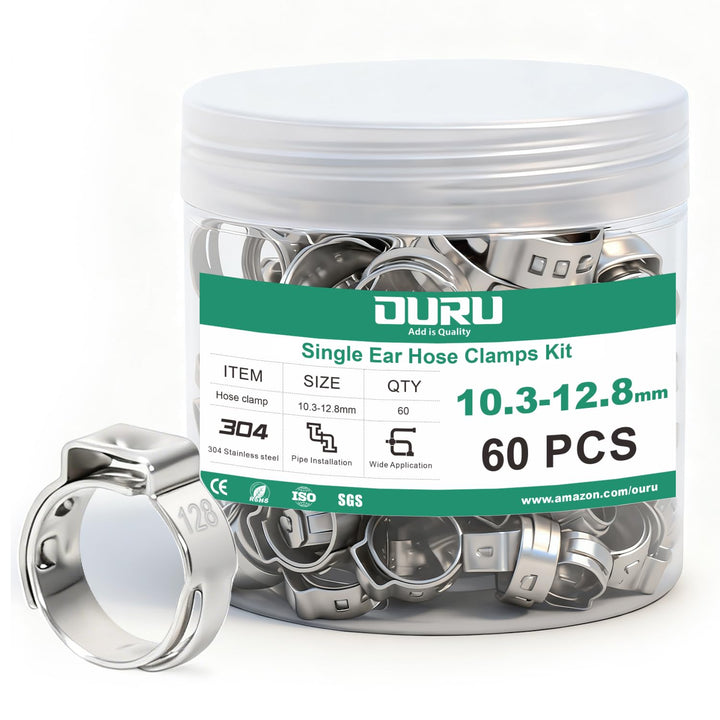
Ear Clamps: Ear clamps (often known by the brand Oetiker clamps) are a crimp-on style of hose clamp. They are metal rings that have one or two little “ears” or tabs sticking out. To install an ear clamp, you slide it over the hose and then use a special tool (ear clamp pincers or pinch clamp pliers) to crimp or squeeze those ears together. Crimping the ear permanently tightens the band around the hose and locks it in place. Ear clamps are single-use (once crimped, you can’t loosen or reuse them), but they provide a very tight and tamper-proof seal. Because of their low-profile and secure fit, they’re frequently used in OEM applications like fuel lines, air hoses, and other situations where you want a clamp that won’t be easily removed or tampered with. You’ll see them on a lot of factory installations in cars (fuel injection hoses often have crimped ear clamps) and appliances. The term “permanent” is often used – you’d typically cut off an ear clamp to remove it. Ear clamps are great for when you want a clean look and a 360° seal with no screw housing (they are often completely smooth on the inside and provide uniform compression all around the hose). The downside for DIY is you need the crimping tool and the correct size clamp for your hose. They also aren’t adjustable once installed. However, they’re relatively cheap and extremely reliable for the long term. If you’ve ever had a car CV axle boot replaced, the mechanic likely used an ear clamp to secure the boot – because it won’t loosen over time. For most hobbyists, ear clamps are used less frequently than worm clamps, but it’s good to know about them. In some cases (like small engine fuel hoses or pneumatic lines), an ear clamp might seal better than a tiny worm clamp because there’s no screw housing gap. If you do use ear clamps, invest in a proper crimp tool for them – it makes installation much easier.
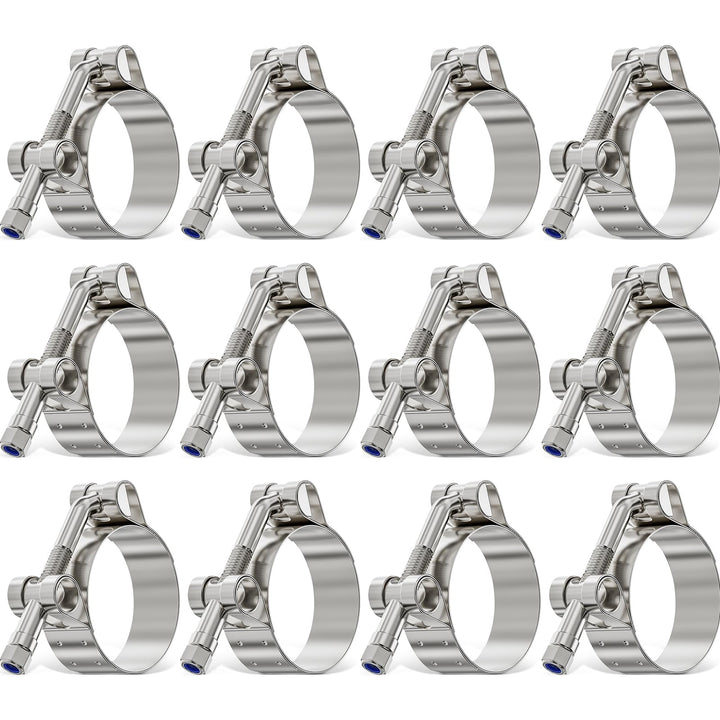
T-Bolt Clamps: When you have a very large diameter hose or a high-pressure application (think turbocharger piping, intercooler hoses, heavy machinery, or large irrigation hoses), T-bolt hose clamps shine. A T-bolt clamp is a heavy-duty band, usually wider and thicker than a worm gear band, with a bolt and nut fastener (the “T”-shaped bolt) that tightens the band. Essentially, it works like a small steel belt around the hose – as you tighten the nut, the band cinches down uniformly. T-bolt clamps can achieve much higher clamping force than standard worm clamps and are highly resistant to vibration loosening. They provide a very strong, even 360° seal (no perforations in the band, smooth inner surface) and are often made entirely of stainless steel for maximum strength. You’ll commonly see T-bolt clamps on performance automotive applications – for example, turbocharger hoses and intercooler connections often use T-bolt clamps exclusively because those hoses deal with high boost pressure and a lot of vibration. In fact, for any critical high-pressure hoses (like on a turbo, or a thick radiator hose on a heavy truck), a regular worm clamp could potentially loosen or strip under extreme conditions; a T-bolt clamp is the go-to for peace of mind. They are also popular in marine and industrial settings for large hoses. If you search for large sizes like a 3″ hose clamp, 4 in hose clamp, or even 8 inch hose clamp, you’ll often find T-bolt styles come up, since beyond a certain size, the worm gear type isn’t as reliable for heavy-duty use. T-bolt clamps are generally reusable (you can loosen the nut and remove them, just like a worm clamp, though it takes a wrench). The only downsides are they are a bit bulkier and usually more expensive than worm clamps, and you need a tool (socket or wrench) to tighten them properly. But for any hose that sees severe service – high pressure, significant pressure spikes, or critical fluids – a T-bolt clamp is cheap insurance. As one manufacturer notes, “T-bolt clamps offer a smooth circle with 360° coverage… One of the strongest hose clamps on the market”. They truly clamp like a steel vise. For example, on a 3-inch turbo piping, a quality stainless steel T-bolt clamp will maintain pressure better under boost and vibration than a worm clamp, reducing the risk of leaks. If you’re not racing cars or dealing with huge hoses, you might not use T-bolts often, but it’s good to know they’re available. Some DIYers also use T-bolt clamps on home brewery setups or high-pressure PVC lines – anywhere a little extra clamping force is needed.
In summary, while worm gear and spring clamps cover 90% of needs, ear clamps and T-bolt clamps fill specific niches: ear clamps for a clean, permanent factory-style fix, and T-bolt clamps for heavy-duty, high-pressure reliability. Knowing about all these types ensures you can pick the best clamp when you have a specialized project.
In conclusion, selecting the right type of hose clamp can make the difference between a secure, leak-free connection and a dripping mess. Worm gear hose clamps are the all-purpose champions – adjustable, easy to use, and suitable for most DIY fixes from automotive to plumbing. Spring hose clamps are excellent for vibration and thermal changes, keeping hoses sealed even as they expand and contract. Ear clamps provide a low-profile permanent seal for critical lines like fuel hoses, and T-bolt clamps deliver heavy-duty clamping force for large or high-pressure hoses. By understanding the strengths of each clamp type, you can approach your next project with confidence, knowing you’ve got the right tool for the job. Always match your clamp size and material to your hose and environment – for instance, use 316 stainless hose clamps in marine or corrosive settings, or double up clamps if needed for extra security on big pipes. And remember, a little preparation goes a long way: keeping an assorted set of quality hose clamps in your garage or workshop (like the Ouru hose clamp kit) means you’ll be ready to tackle leaks or repairs of any size at a moment’s notice. Tightening up a leaky connection is a simple task with the correct clamp on hand. So next time you’re confronted with a squirting radiator hose or a loose washing machine line, you’ll know exactly which clamp to grab! Happy clamping, and may all your DIY projects stay dry and secure.
{"one"=>"Select 2 or 3 items to compare", "other"=>"{{ count }} of 3 items selected"}
Leave a comment