Skip to content
How to Know if a Hose Clamp Is Tight Enough?

How to Know if a Hose Clamp Is Tight Enough?

When working on projects from car repairs to plumbing, DIYers often wonder how tight a hose clamp should be to prevent leaks without causing damage. A hose clamp (often a worm drive clamp or worm gear clamp) that’s too loose can leak or slip off, while one that’s too tight can damage the hose or the clamp itself. Striking the perfect balance is key. Whether you’re using a small 1 inch hose clamp on a fuel line or a heavy-duty 4 inch hose clamp on a radiator hose, the goal is the same: tight enough to seal, but not so tight it ruins the hose. In this guide, we’ll explain exactly what “tight enough” means for stainless steel worm clamps, how to perform visual checks, and how proper tightening feels by hand. By the end, you’ll know how to secure anything from tiny #6 mini hose clamps to large 8 inch or even 12 inch hose clamps with confidence.

What “Tight Enough” Really Means for a Hose Clamp

Getting a hose clamp “tight enough” means achieving a secure, leak-proof seal without crushing or cutting into the hose. Practically, this translates to tightening until the hose won’t slip off and fluid won’t leak, but stopping short of any damage. Industry experts sum it up well: a clamp should be “tight enough to prevent slippage, but not so tight that it damages the hose”. In other words, snug and secure is the target.

For common stainless steel worm gear clamps, this usually corresponds to a certain torque range. If you have a small torque wrench, you can actually measure how tight you’re turning the screw. Many standard worm clamps (the typical metal clamps for pipes like car radiator or fuel line clamps) are tightened to around 20–30 inch-pounds of torque. To give a sense of scale, light-duty clamps (say for a 3/4″ hose) might take roughly 10–30 in-lbs, whereas a large heavy duty stainless steel hose clamp on a 4″ hose could require 60+ in-lbs. Always refer to the manufacturer’s specs when available, since each clamp design can vary. Tighten within the recommended range so that the stainless steel band provides a good seal without deforming. Overtightening beyond spec can strip the threads or crack the clamp, while under-tightening can lead to a weeping leak.

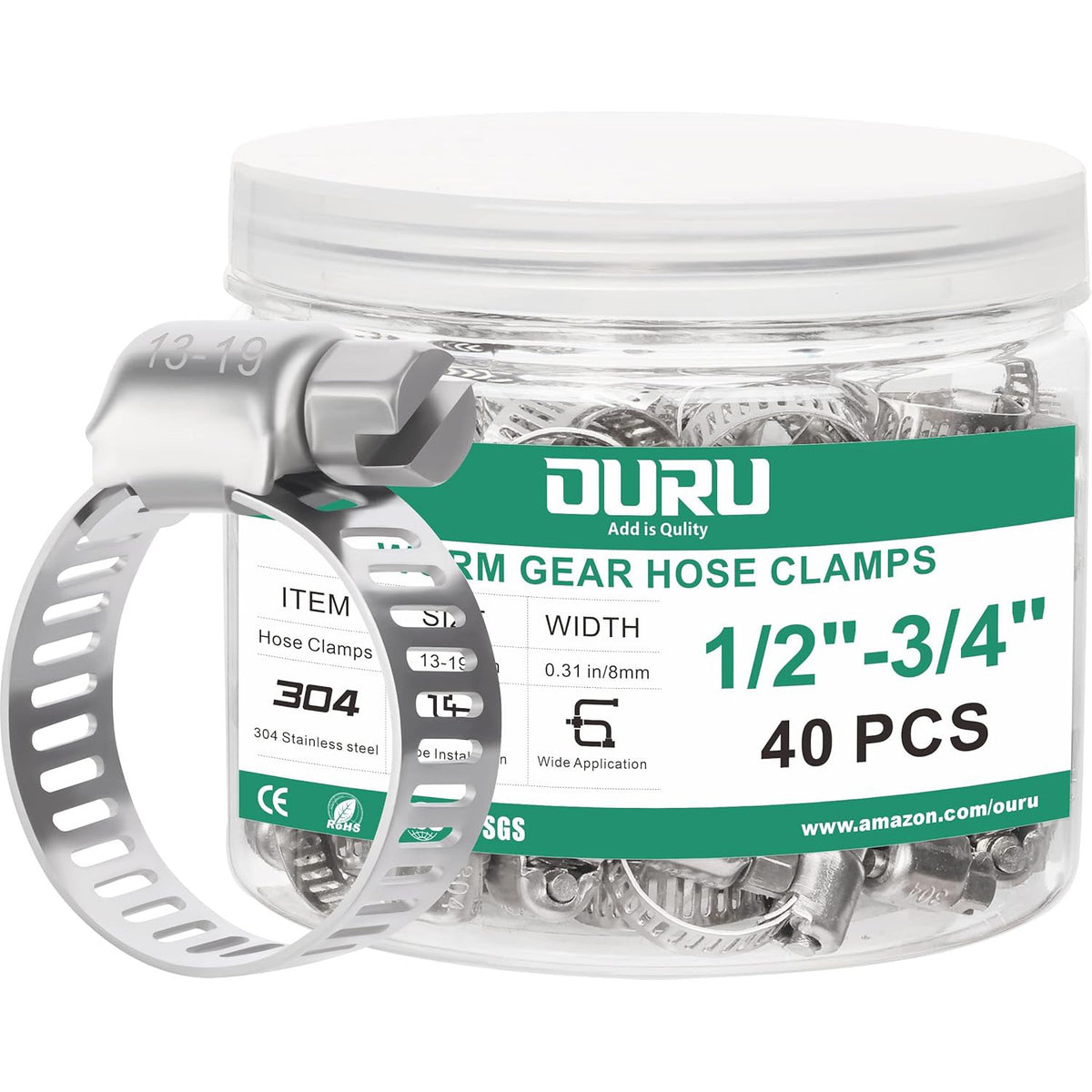
What are the consequences of not hitting this “just right” tightness? If a clamp is too loose, the hose might slip off under pressure or you’ll notice leaks at the connection. If it’s too tight, you may see the hose material being cut or extruding through the clamp’s slots, or even the clamp’s screw housing starting to bend. In extreme cases, an over-tightened clamp can damage the hose so much that it tears or collapses. The ideal state is when the clamp is securely gripping the hose (no movement or leaks) but the hose is only slightly compressed, not crushed. Using quality clamps helps here – for example, Ouru’s clamps use 304 stainless steel with rolled band edges to grip firmly without “biting” into the hose. Upgrade your project with Ouru’s premium stainless steel worm clamp kit (assorted sizes) for reliable tightening every time! 🔧🛠️ Shop Ouru Hose Clamps

Scene demonstrating automotive hose clamp versatility: stainless worm gear clamps in kits, while a user tightens a clamp on piping.

Visual Checks — What a Properly Tight Clamp Looks Like

One of the best ways to tell if a hose clamp is tight enough is by visual inspection. A properly tightened worm screw clamp will sit evenly around the hose, with the band lying flat and the screw housing not skewed. Proper alignment is crucial – the clamp should be perpendicular to the hose and positioned just behind the hose barb or fitting ridge (usually about 1/4” from the hose end). If the clamp is cocked at an angle or off the fitting, it won’t seal uniformly. In fact, misalignment leads to uneven pressure and increases the risk of leaks. So the first visual check is ensuring the clamp is straight and in the right spot on the hose (not hanging off the hose edge, and not on top of the hose’s flare or bead).

Next, look at how the hose material under the clamp appears. You want to see the hose compressed slightly under the clamp’s band, but not bulging or deeply cut. The hose shouldn’t look pinched or extruded through the clamp’s perforations. If you notice the hose’s rubber squeezing up through the slots of a slotted clamp, that means the clamp may be too tight (or you might need a different style like a lined clamp to protect the hose). Also, check the clamp band itself for any signs of stress. Cracks or deformities in the metal band or screw housing are red flags that the clamp has been over-tightened. A clamp in good condition will maintain its circular shape; if you see it bending or the screw mechanism twisting, it’s probably beyond “tight enough” and into over-tightening. On the flip side, if the clamp is too loose, you might literally be able to see gaps or feel looseness – for example, you might notice the hose can still rotate or slide on the fitting, or even see a bit of fluid seeping out. A loose clamp that you can move around is a clear warning sign of under-tightening.

One specific thing to check on worm-drive clamps is the band tail position. As you tighten, the free end of the band comes around and approaches the screw housing. Ideally, when fully tightened, there should still be a slight gap between the band’s end and the housing – it shouldn’t bottom out completely. In fact, one guide suggests stopping when there’s roughly a 2 mm gap left between the band ends, once you’ve reached good resistance. If the band tail has run out of slot and the ends meet, the clamp might be too small for the job or fully tightened down (potentially too much). With the correct size clamp, a proper tightness usually leaves a small visible gap, indicating you haven’t maxed it out.

Finally, look for leaks once the system is pressurized. After you think the clamp is tight, do a test: either run the fluid through (e.g. pressurize a coolant line or turn on the water) or at least wipe the area dry and see if any moisture appears after a few minutes. A properly tightened clamp will not show any signs of leakage under normal pressure. If you do see a slow drip or wetness, that’s a clue the clamp may need a bit more tightening (or in some cases, that you need a second clamp or a different clamp type for a high-pressure line). Visually inspect around the clamp for any droplets. No leaks plus the hose and clamp looking as described – that’s how you know you’ve likely hit the sweet spot. For added assurance, high-quality 316 stainless hose clamps (often labeled as marine hose clamps) offer superior corrosion resistance and consistent tension – a smart choice for boat, pool, or outdoor plumbing where you’ll be visually checking clamps over the long term. 🌊🔩

Hand-Feel Checks — How It Should Feel When You Tighten

Aside from visual cues, an experienced DIYer can also feel when a clamp reaches proper tightness. As you tighten a worm gear clamp with a screwdriver, nut driver, or small socket, pay attention to the turning resistance. In the beginning, the screw turns relatively easily as it takes up slack. But as the clamp band begins to really squeeze the hose, you’ll feel the screw require more effort to turn. That’s your cue that you’re nearing the right tightness. Many mechanics describe it like this: tighten gradually until you feel a firm resistance, then give a small additional turn for security. In practice, that might mean once the clamp feels snug, you turn another 1/4 turn (90 degrees) or so. You do not want to keep cranking beyond that, as that’s when you risk stripping the clamp or cutting the hose. One popular rule of thumb: tighten until you can’t easily move the hose on its fitting by hand, plus just a little more – that ensures it’s not going anywhere, without going overboard. If the hose still twists or can be pulled off, you need more tension; if it’s rock solid after that slight extra turn, you’re tight enough.

For those who prefer more quantifiable guidance, using a small torque wrench can be very helpful on worm clamps. As mentioned earlier, around 20–30 in-lb is a common spec for many standard stainless steel worm clamps. Heavier-duty worm drive clamps or T-bolt clamps may allow higher torque (40–60+ in-lb) but generally you won’t achieve that by hand with a screwdriver anyway – that’s typically when using a ratchet or wrench. If you are using a 1/4” drive ratchet, be cautious: it gives more leverage than a screwdriver, so it’s easier to over-tighten inadvertently. A good approach is to use a screwdriver for that “feel” – when it gets hard to turn, you’re basically there. If using a ratchet, go slowly and feel for the point when the clamp resists firmly. In fact, one source advises to tighten gradually and aim for a snug fit that slightly compresses the hose without causing any visible distortion. The hose under the clamp should feel firm if you squeeze it, but not rock-hard (which would imply you crushed it).

Another tactile clue: if you ever hear a “pop” or sudden snap while tightening, that’s bad – it often means the clamp just slipped a thread or something gave way (immediate over-tighten warning!). You should feel a smooth increase in resistance, not a jump. Also, once tight, try to wiggle the clamp housing gently – it should not wiggle or turn; it should be stationary on the hose. If it moves, it’s still too loose. On the other hand, if you physically can’t tighten further without a lot of force, don’t push it – you’re likely at the limit.

Keep in mind that different clamp types have different “feel”. A spring clamp (the kind you squeeze with pliers) will feel completely different – it’s either fully engaged or not, and it’s designed to apply consistent tension on its own. If you’re using ear clamps or crimping hose clamps (where you crimp a metal ear with special pinch clamp pliers), you don’t really get to choose tightness – those are crimped fully by design. But for adjustable clamps like worm, T-bolt, or band clamps, feel is everything. Practice helps a lot: over time, you’ll get a calibrated sense in your hands for what is just tight enough. If in doubt, err on the side of slightly less tight, then run the system and see if any leak occurs – you can always tighten a bit more if needed. It’s much harder to undo damage from overtightening. And using quality clamps with smooth threading (like Ouru’s clamps, which have a solid worm screw clamp design) gives a more predictable tightening feel – the screw won’t bind or jump, so you can tighten steadily and confidently.

Dishwasher hose clamp pack with adjustable stainless worm gear clamps, sorted by diameter in case; driver tool included.

Bonus Tip: If you have a critical connection (say a hydraulic line clamp or coolant hose on a car), it’s a good idea to re-check the clamp after the system first heats up and cools down. Hoses can “settle” or compress slightly after exposure to heat and pressure, which might make a previously tight clamp a tad looser. Many professionals will give the clamp a second tightening after a cycle – just a quarter turn if needed – to maintain a leak-proof seal. This ensures your hose stays secure for the long haul.

Conclusion

In summary, knowing if a hose clamp is tight enough comes down to preventing leaks without causing damage. Visually, a correctly tightened clamp is aligned, snug against the hose (with the hose slightly compressed), and shows no signs of strain or gaps indicating looseness. By feel, the clamp becomes firmly resistant to turn just as it achieves a solid hold on the hose. Always tighten gradually and evenly – the clamp should be snug but not cutting into the hose, and often around 20–30 in-lb of torque for a standard stainless steel worm clamp (check specs for larger sizes). If you see drips, give it a bit more; if the hose is being cut or the clamp is deforming, you’ve gone too far. Remember that factors like hose material and temperature cycles can affect clamp tightness over time, so re-checking after initial use (especially for marine hose clamps or high-heat automotive hoses) is a wise step.

By following the visual and hand-feel checks outlined above, you’ll develop an intuition for the “just right” tightness. Using quality stainless steel clamps with good design also makes the job easier – they tighten more smoothly and hold better with less effort. If you’re still unsure, a small torque screwdriver can take the guesswork out, but for most DIY situations, careful attention and these best practices will suffice. No more anxiety about “one more turn” – you now know how to set that clamp confidently!

Finally, don’t underestimate the value of a reliable clamp. A tiny $1 worm hose clamp can be the difference between a dry, functioning system and a messy leak or blown hose. Invest in good clamps and tighten them correctly. To help with that, consider keeping an assortment of common sizes on hand. Ouru offers a comprehensive hose clamp kit with a range of sizes (from mini 1/2 inch hose clamps up to larger 2 inch hose clamp sizes and beyond) all made from high-grade stainless steel. Having the right size clamp and a quality build means you can achieve proper tightness with confidence. Plus, Ouru’s kit comes with a handy driver tool – making it easy to get that perfect snug fit on any hose in your project. Check out the product link above to grab this kit for your toolbox, and ensure every clamp you tighten is the right clamp used the right way. Happy DIY clamping, and enjoy leak-free, secure connections! 🚗🚰🔧

Sources:
https://jlcmc.com/blog/how-to-use-hose-clamps-correctly
https://www.torkclamps.com/common-mistakes-and-correct-practices-in-hose-clamp-assembly/
https://wolfchestershop.com.au/blog/how-to-properly-install-and-tighten-hose-clamps-for-maximum-performance/

Previous article How to Tighten a Loose Clamp?
Next article How to Fix a Loose Hose Clamp?

Leave a comment

* Required fields

Compare products

{"one"=>"Select 2 or 3 items to compare", "other"=>"{{ count }} of 3 items selected"}

Select first item to compare

Select second item to compare

Select third item to compare

Compare