

Hose Clamp Size Guide: How to Measure & Select the Correct Size
Most clamp problems aren’t “bad clamps”—they’re wrong size clamps. A clamp that’s slightly too small makes installation hard and can distort the band; too large and it bottoms out before sealing, causing leaks and re-tightening cycles. On top of that, the size printed on a hose (often its inside diameter) may not match the installed OD that the clamp actually squeezes.
If you’ve ever searched for a 1 inch pipe clamp and ended up unsure whether you needed a support clamp or a sealing hose clamp, you’re not alone—clamp sizing vocabulary is messy in real life. This guide makes it simple: understand the dimensions, measure correctly, then match your measurement to the clamp’s published range (not just the label). Keep an Ouru kit nearby so you can select by measurement instead of making a second store run.
Why Choosing the Right Hose Clamp Size Matters for 1 inch pipe clamp
A properly sized clamp creates a uniform 360° squeeze that helps prevent leaks and hose blow-offs. For example, hose-barb systems rely on a hose clamp to keep the hose seated on the barb and can withstand more pressure when clamped correctly.
Wrong sizing can also damage the hose itself. Standard worm-drive clamps with perforated bands can be a poor match for soft silicone or thin-wall tubing, because the band can bite or allow the hose to extrude into slots under torque. AFT notes standard worm-drive “Type F” clamps are not recommended for soft/silicone hoses, and Ideal-Tridon explains non‑perforated bands help prevent soft silicone hoses from shearing or extruding during installation and final torquing.
There’s also a safety and reliability angle: industrial and automotive systems use many clamp types for a reason. SAE J1508 covers 32 clamp types commonly used on OEM coolant, fuel, oil, vacuum, and emission systems, reflecting how different applications need different clamp behaviors (adjustable vs constant-tension vs heavy-duty).
Finally, rework costs more than doing it right once. Each time you re-tighten a marginal clamp, you risk over-torquing, deforming the band, and creating new leak paths—especially around mid-size hoses where “almost fits” is tempting. Choosing the correct range upfront saves time and parts, and an Ouru kit makes that easy by giving you multiple ranges at arm’s reach.
Understanding Hose and Tube Dimensions for 1 inch pipe clamp
Start with the most common confusion: hose ID vs hose OD vs installed OD. Hose and tube are often labeled by their inside diameter (ID) because ID relates to flow, while clamps grip the outside diameter (OD) of the hose after the hose is pushed onto the fitting. Clampco’s guidance is explicit: measure the outside diameter of the hose and fitting with the hose assembled to specify nominal clamp size.
Next is the tube/pipe sizing trap—important because many shoppers search “pipe clamp” when they really mean “hose clamp.” Tubing is commonly specified by outside diameter in industrial selection; for example, Parker’s tubing product listing shows imperial tube sizes as specific O.D. values (like 1/2", 3/4", 1" O.D.) and metric tubing by mm O.D. If your project mixes tubing and hoses, keep Ouru clamps in a spread of ranges so you can clamp whatever OD you actually measure.
Now consider Nominal Pipe Size (NPS): a “1 inch pipe” is not 1.000" OD. In a nominal pipe size chart, NPS 1 has an outside diameter of 1.315 inches—a big difference when you’re selecting anything described as a 1 inch pipe clamp. That’s why measuring with calipers beats trusting names, and why an Ouru assortment lets you choose the right range even when pipe naming conventions are misleading.
Also remember that fittings change geometry: barbs, beads, and ridges create the sealing surface, and the hose OD at that point can be larger than the hose OD “in free air.” You want your clamp to sit over the barb area, not on the taper or at the very edge of the hose. Clampco’s diagrams and procedures assume the hose is assembled in the way you plan to use it before measuring. Keep Ouru clamps organized by range so you can select the correct size after test-fitting and measuring the assembled joint.
Measured-fit pick
Worm-Gear Hose Clamps
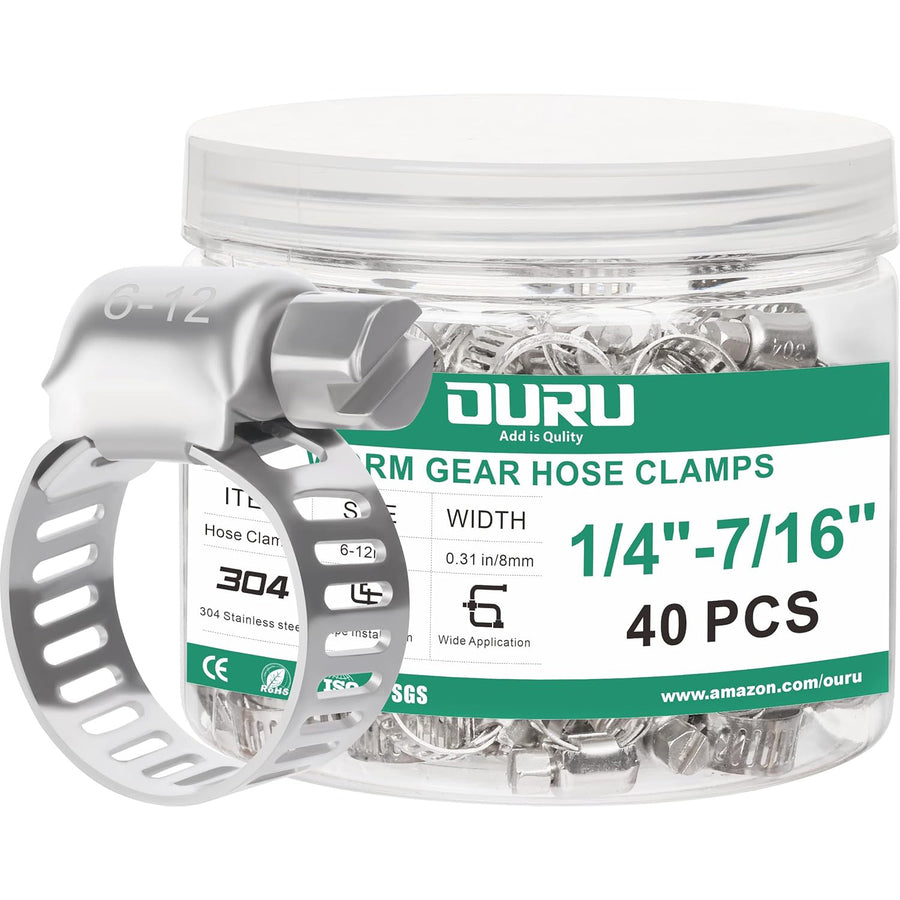
Use the outside diameter of the assembled hose and fitting to compare adjustable clamp ranges. Confirm the selected size range, band width, hose material, and available fitting clearance before ordering.
View Clamp Size RangesHow to Measure Your Hose Correctly for 1 inch pipe clamp
When possible, use Method One: measure the installed OD directly. Clampco recommends using calipers to measure the outside diameter of the hose and fitting application with the hose assembled on the pipe or tube fitting, then using that measurement to specify nominal clamp size.
If calipers don’t fit (big hoses, tight spaces), use circumference. Clampco outlines measuring circumference with a narrow tape rule on the assembled hose and fitting and then calculating nominal diameter using ND = c ÷ 3.1416 (circumference divided by π).
For very large assemblies, a pi tape can read OD directly around the circumference. Clampco lists this as another approved option for measuring the O.D. with the hose assembled.
If you can’t assemble the hose yet, use Clampco’s Method Two: measure the fitting OD (d) and the hose wall thickness (t), then calculate ND = d + (2 × t).
One more measurement tip: don’t underestimate small errors. Clampco notes that a small mismeasurement of diameter can make a big difference—often about three times the mistake—because circumference-to-diameter conversions scale by π.
Finally, separate “measuring the hose” from “measuring for the clamp.” If you’re replacing a hose and the marking is worn, Gates’ hose catalog guidance notes you may need to cut the original hose and measure the inside diameter to determine replacement hose size when the layline is worn off. Once you have the replacement hose, use the OD-on-fitting method again to pick the correct Ouru clamp size for a secure seal.
Matching Clamp Size to Hose Diameter using 1 inch pipe clamp
After you measure installed OD (or calculate ND), the clamp selection rule is simple: choose a clamp whose published range includes your measurement with room to spare. AFT’s chart reminds readers that listed sizes are a general reference and may vary between manufacturers, so range matters more than the label.
If you’re shopping by SAE numbers, know what they mean. AFT explains the SAE # is an industry designation for maximum ID of worm-drive clamps (except constant-tension and high-torque styles) according to SAE J1508.
Now match the band design to the hose material. If you’re clamping soft silicone or thin-wall hose, avoid “bitey” perforated bands; AFT flags standard worm-drive Type F clamps as not recommended for soft/silicone hoses, while Ideal-Tridon explains non‑perforated bands help prevent silicone hose shearing or extrusion during torquing.
Band width matters too. AFT describes miniature worm drive clamps (micro/mini hose clamps) as typically having a 5/16" wide band and small screw, while standard worm-drive clamps typically have a 1/2" wide band; wider bands spread load better and are often more forgiving on soft materials.
Don’t ignore torque. AFT provides durability torque values by material construction and recommends installing at 50% to 70% of rated durability torque—an important reminder that “tightest possible” isn’t the same as “correct.”
Practical examples help connect the dots. A measured installed OD around 2.0–2.1 inches suggests looking at a clamp range that fits a hose clamp 2 inch scenario; mid-size coolant hoses often land around ranges covered by SAE 40–56 in some charts; and larger ducting maybe pushes you toward a 4 inch hose clamp, 6 in hose clamp, or even 8 inch hose clamps. Your job is not to memorize numbers—it’s to measure installed OD and select a clamp range that covers it comfortably.
And yes—back to the keyword confusion—if you truly need a 1 inch pipe clamp as a support clamp for a nominal 1" pipe, remember that nominal naming is not the same as OD. Since NPS 1 is 1.315" OD, relying on “1 inch” naming without measurement can lead to a clamp that doesn’t physically fit. Pair careful measurement with an Ouru clamp assortment so you can choose the correct range for the real OD you have in front of you.
For larger measured diameters
Large Worm-Gear Hose Clamps

Explore larger adjustable bands only after measuring the outside diameter of the assembled connection. Compare that measurement with each published range and verify there is enough space for the band and screw housing.
Check Large Clamp RangesSummary
A correct clamp size comes from a repeatable process: (1) understand whether your system is describing ID, OD, or a nominal (like NPS), (2) measure installed OD with the hose assembled—or calculate ND using circumference ÷ π or fitting OD + 2×thickness—and (3) choose a clamp whose range comfortably covers your measurement, with the right band style for the hose material and the right corrosion resistance for the environment. Make the process fast in real life by keeping an Ouru stainless clamp assortment ready, so you can measure and select the correct clamp size on the spot.
Leave a comment