

Hose Clamp Size Guide: How to Measure & Select the Correct Size
Why Hose Clamp Size Matters: The Key to Leak-Free Seals
Using the right size hose clamp is the key to a leak-free seal on your hoses and pipes. If a clamp is too small, it simply won’t fit around the hose; if it’s too large, it may not tighten down enough to grip the hose properly. In both cases, you’re likely to get leaks – or even a hose that pops off under pressure. A loose clamp can allow fluid or air to seep out, defeating the whole purpose of the clamp. That’s why plumbers and savvy DIY homeowners always double-check they have the correct size before tightening a clamp.
The importance of proper sizing can’t be overstated – especially for critical connections like fuel lines, coolant hoses, or high-pressure lines. Even a tiny leak in a fuel hose can be dangerous: it wastes fuel, hurts performance, and in worst cases could start a fire. Using a clamp that fits just right ensures a tight, uniform seal all around the hose. An undersized clamp may not even latch, whereas an oversized clamp might bottom out (tighten to its limit) without ever truly cinching the hose. In other words, close enough is not good enough when it comes to clamp size. For example, don’t try to use a huge 4 inch hose clamp on a small 2-inch hose – it will tighten all the way but still be loose, leading to leaks. Conversely, forcing a small clamp onto a hose that’s slightly too large can warp the clamp or damage the hose. In both scenarios, you’re risking a leaky connection and potential hose failure.
On top of leak prevention, the correct size clamp also protects your equipment. Hoses clamped with the right size stay put even under pressure surges or vibration. If you have the wrong size, you might be tempted to overtighten a large clamp to compensate – which can strip the threads or crack the hose. The proper size requires only a normal amount of tightening to achieve a seal. This is especially critical in high-vibration applications (like automotive engines or marine systems) where a slightly loose clamp can wiggle free over time.

Hose Clamp Size Chart: Understanding the Standard Measurements
When we talk about “hose clamp size,” we’re referring to the clamp’s adjustable diameter range – essentially the minimum and maximum diameters that the clamp can snugly tighten to. Most hose clamps (especially worm gear clamps) are adjustable within a certain span. For example, a clamp might be labeled as “Fits 1/2 inch (13mm) to 1-1/4 inch (32mm)”. This means its band can tighten down to as small as 1/2″ diameter and loosen up to as large as 1-1/4″ diameter. The hose or pipe you are clamping needs to have an outside diameter that falls somewhere in that range. A good rule of thumb is to choose a clamp where your hose’s diameter lands in the middle of the clamp’s range for optimal tightening. This way, the clamp isn’t at either extreme end of its capacity. If your hose’s OD (outside diameter) is very close to the clamp’s minimum or maximum, you might want to go one size up or down to be safe.
Finally, it’s worth noting that not all sizing is in inches. Many clamp charts will list both inches and millimeters, and some use metric designations especially outside the US (for example, a British Standard size might be called out by a range in millimeters instead). But the concept is the same. Always rely on the actual diameter range. If a clamp is labeled in a nominal size (like “1/2 inch hose clamp” or “1 inch hose clamp”), double-check the fine print for the range. Usually, a “1 inch hose clamp” will not mean it only fits exactly 1.000″ – it means it’s meant for around that size (often spanning perhaps 3/4″ to 1-1/4″). For precision, look at the range numbers. And when in doubt, measure your hose OD and choose a clamp that covers that measurement. By understanding the standard measurements and charts, you can quickly narrow down which clamp you need for any given hose diameter.

Hose Clamp Types and Size Compatibility: Matching Clamp Type to Hose Size
Selecting the correct size clamp is step one; step two is choosing the right type of hose clamp for your application and hose size. Different clamp designs have different strength, adjustment ranges, and best-use scenarios. Here we’ll cover the main types – worm gear clamps, T-bolt clamps, spring clamps, and ear (Oetiker) clamps – and how they relate to hose size and usage. Matching the clamp type to your hose ensures not only that it fits, but that it performs well (e.g. holds pressure, resists corrosion, handles vibration, etc.) for that size and situation. Let’s go through the common types:
-
Worm Gear Clamps (Worm-Drive Clamps): This is the classic, most common hose clamp – a metal band with a screw mechanism that you tighten with a screwdriver or nut driver. Worm gear clamps have a perforated band and a worm screw that engages the slots, allowing the band to tighten around the hose as you turn the screw. These clamps are very versatile and come in a wide range of sizes. You’ll find miniature worm-drive hose clamps for small hoses (even under 1/2″ diameter) and larger stainless steel worm gear clamps that can go 6 inches or more. In fact, standard worm clamps can be found for anything from tiny 1/4″ fuel lines up to large 8-inch ducting. They are often sold by size range, as discussed in the chart section. For example, you could get a worm hose clamp labeled “fits 2” to 3″, which would be perfect as a hose clamp 2 inch in diameter and a bit beyond. Worm gear clamps are the go-to for most everyday applications – automotive hoses, garden hoses, plumbing repairs, etc. They provide a strong, adjustable grip and are reusable. For most DIY or general use, a worm gear clamp of the right size (preferably in stainless steel for corrosion resistance) will do the job. One thing to note: worm clamps are not usually rated for extremely high pressures (like hydraulic systems) and they do have limits. But for the vast majority of low to moderate pressure uses, they’re ideal.
-
T-Bolt Clamps (Heavy-Duty Clamps): T-bolt clamps are the heavy-duty big brother to the worm clamp. They feature a sturdy band (often wider and thicker than worm clamps) and a bolt and nut tightener (forming a “T” shape when assembled) instead of a worm screw. When you tighten the nut on a T-bolt clamp, it draws the band tight with very high tension. These clamps are designed for high-pressure and high-vibration applications – for example, turbocharger or intercooler hoses on performance cars, heavy truck radiator hoses, or industrial machinery hoses. They provide more uniform 360° pressure and can handle larger diameters with greater clamping force. T-bolt clamps typically start at larger sizes; you generally won’t find tiny T-bolt clamps for a 1/4″ hose. They’re more common in sizes like 1.5″ up to 8″ or more, where a worm clamp might not be strong enough. For instance, a 2” fuel filler hose or a 3” intake hose might use a T-bolt clamp to ensure a leak-proof seal under stress. If you need a 6 inch hose clamp on a critical line, a T-bolt style would likely be preferable to a standard worm drive, due to the higher torque it can apply. Many heavy duty stainless steel hose clamps are of the T-bolt variety, often made from 100% stainless (bolt, band, and nut) for maximum corrosion resistance and strength. These are sometimes called “heavy duty hose clamps stainless steel” or “stainless steel heavy-duty hose clamps.” They excel in marine, industrial, or racing environments.
-
Spring Clamps (Constant Tension Clamps): Spring clamps, also known as constant-tension or constant-torque clamps, are the kind you often see on OEM car hoses (like radiator or heater hoses) – a ring of spring steel that you expand to slip over the hose, and then it clamps down with spring force. These include flat band spring clamps and wire clamps. The idea is that they maintain tension even when the hose material expands and contracts (for instance, due to temperature changes). Spring clamps are usually sized exactly to a particular hose diameter (with a specific range/tension); they don’t have a wide adjustability like worm clamps. For example, a spring clamp might be made for a 3/4″ hose and will work in a small range around that size. If the hose is a bit bigger or smaller, you need a different size spring clamp. They come in standard increments to match common hose sizes (1/4″, 3/8″, 1/2″, 5/8″, 3/4″, 1″, etc.). Spring clamps are great for maintenance-free connections – once installed, they continuously apply the right pressure, even if the hose rubber sets or swells, the spring will adjust. However, you need the exact right size for a spring clamp to work well. They also require a tool (special hose clamp pliers or even generic pliers) to expand and install, especially the automotive ones with “rabbit ear” tabs. One advantage is they don’t have screw mechanisms, so they won’t strip or cut into a hose, and they tend to distribute pressure evenly. You might use spring clamps on applications like coolant lines, fuel lines (some small gas line clamps are spring style), and other scenarios where space is tight or you want a clamp that self-adjusts.
-
Ear Clamps (Oetiker Clamps): Ear clamps are a type of crimp-on clamp often used for fuel lines, air lines, and other critical connections where a permanent, tamper-proof clamp is desired. They are called “ear” clamps because they have one or two little loops (ears) that you pinch with special pinch clamp pliers (also known as clamp crimping pliers) to tighten the band. Once crimped, they’re essentially locked in place and not easily removable (except by cutting them off). Ear clamps provide a very uniform compression around the hose and can be very space-efficient (low profile). However, like spring clamps, each ear clamp is made for a specific diameter range – there is a small amount of stretch when you crimp, but you must choose the size carefully. For instance, you might have an ear clamp that suits a 1/2″ (13mm) hose when crimped. If your hose is 5/8″, you’d need the next size up clamp. These are commonly seen on fuel injection hoses in cars, on pneumatic lines, and even on some plumbing (like PEX tubing uses a similar concept with crimp rings). The benefit is a secure, permanent seal with no loose tail (unlike worm clamps which have a tail and can potentially be overtightened or loosened). Ear clamps are typically all stainless steel or zinc-plated steel. For example, you might buy a kit of 1/2 inch hose clamps of the ear style for your fuel line repairs – just be sure you have the right size for your hose O.D. and a proper crimping tool.
As you can see, each clamp type has an ideal usage and size range. Worm gear clamps cover the broadest range and are adjustable, making them the default choice for most scenarios from small to fairly large hoses. T-bolt clamps take over for the really high-demand, larger diameter tasks where extra clamping force is needed (usually 1.5″ hose and above, like heavy truck or performance applications). Spring clamps and ear clamps are more about specific sizing – you match them exactly to a given hose and application, often seen in OEM setups – and they provide benefits like constant tension or low profile, but lack the broad adjustability. No matter the type, always choose good material for the clamp: stainless steel is preferred for longevity and strength. For marine or corrosive environments, use 316 stainless hose clamps if available (A4 marine grade) because salt water can corrode even regular stainless over time. For automotive, stainless steel worm clamps are standard to prevent rust. Avoid plain steel clamps on any fuel or water lines – they rust quickly and can fail. Also consider band width: wider bands (like 1/2″ wide) protect soft hoses better by distributing force, while narrower bands (1/4″ or 5/16″) are used on small hoses where space is tight (often called miniature hose clamps).
Before we conclude, don’t confuse hose clamps with pipe clamps – they’re completely different tools. In plumbing and construction, a “pipe clamp” usually refers to a bracket or device that holds a pipe to a wall or support (for example, a ceiling hanger, U-bolt, or a riser clamp for vertical pipes). These pipe clamps (such as insulated pipe clamps or riser clamps) are for securing rigid pipe in place and have nothing to do with sealing a hose connection. They come in sizes like 1 inch pipe clamp or 8 inch pipe clamp, but those refer to the pipe diameter they hold, not a sealing function. A plumber might say “grab a 1-inch pipe clamp” meaning a hanger to hold a 1″ iron pipe to the wall. Pipe clamps often have rubber cushions (for noise/vibration damping on copper lines) or are heavy duty U-bolts for clamping pipe (like exhaust pipes on a vehicle). They do not stop leaks – they’re purely support devices. So, do not use a pipe hanger clamp in place of a hose clamp! In our context here, we are focusing on hose clamps (sometimes called hose clips) which are meant to seal flexible hoses onto barbs or fittings. It’s an important distinction: pipe clamps = support, hose clamps = sealing. Make sure when you shop that you’re getting the right type for your needs.
In summary of clamp types: use worm gear clamps for most general purposes and keep a range of sizes in your toolbox (they’ll cover everything from small 1 inch hose clamps on a home plumbing repair to a hose clamp 4 inch for a dryer vent or dust collection hose). Switch to T-bolt clamps for large diameter or high-pressure situations where you need extra strength and a sure seal (common in performance automotive or marine engine uses). Use spring clamps when you want automatic tension adjustment (common on engine coolant hoses) and have the exact right size, and use ear clamps for permanent, professional-looking connections on fuel or air lines when you have the crimp tool. By matching the clamp type and size to the hose, you’ll ensure a secure fit and a long-lasting, leak-free connection.

Choose by Your Measured Outside Diameter
Measure the hose outside diameter while it is installed over the fitting, then choose a product whose minimum-to-maximum adjustable range covers that measurement. Do not select a variant from nominal hose size or SAE number alone.
Worm-Gear Hose Clamps
Choose an adjustable clamp range that covers the measured hose diameter over the fitting. Check the selected variant before ordering.
View Standard Size Options
Large Worm-Gear Hose Clamps
Explore larger adjustable bands for compatible large-diameter connections. Verify the assembly diameter and available fitting space.
View Large Size OptionsNo matching range? Do not force a purchase. Compare the full hose clamp collection.
Next step: Once the size is confirmed, read How to Tighten a Hose Clamp.
Conclusion: Measure Twice, Clamp Once – Achieving Perfect Seals
Choosing the correct hose clamp size is a small step that makes a huge difference in the success of your project. It’s all about that Goldilocks fit: not too tight, not too loose, but just right for a leak-free seal. We’ve seen why it matters – the right size clamp prevents pesky drips, protects against sudden blow-offs, and avoids damage to your hose or equipment. By taking a moment to measure the hose’s outside diameter (remember to do it with the hose on the fitting, and maybe add that little 1/8″ buffer for safety), you set yourself up for success. Then, using a hose clamp size chart or the guidelines we discussed, you can pick a clamp that comfortably encompasses that size. Whether you’re dealing with a small fuel line on your lawn mower or installing a hefty 2-inch radiator hose in your truck, there’s a proper clamp for each. And as we’ve learned, the type of clamp matters too: you wouldn’t use a tiny spring clamp on a big job that calls for a beefy T-bolt, or vice versa.
For plumbers, mechanics, and DIY homeowners alike, the key takeaways are: measure accurately, choose the clamp that fits the range, and opt for quality. A well-chosen clamp of the right size (be it a hose clamp 1 inch in diameter for a minor repair or an 8 inch hose clamp for a large pipe) will save you headaches down the road. You’ll prevent leaks that can cause water damage, fluid loss, or safety hazards, and you’ll ensure your connections hold under pressure. It’s impressive how something as humble as a hose clamp can be the difference between a dependable system and a sloppy one. The good news is that clamps are inexpensive, so there’s no reason not to use the correct size and even double up clamps on very large or critical connections if needed (sometimes two clamps side by side are used on high-pressure large hoses for extra security).
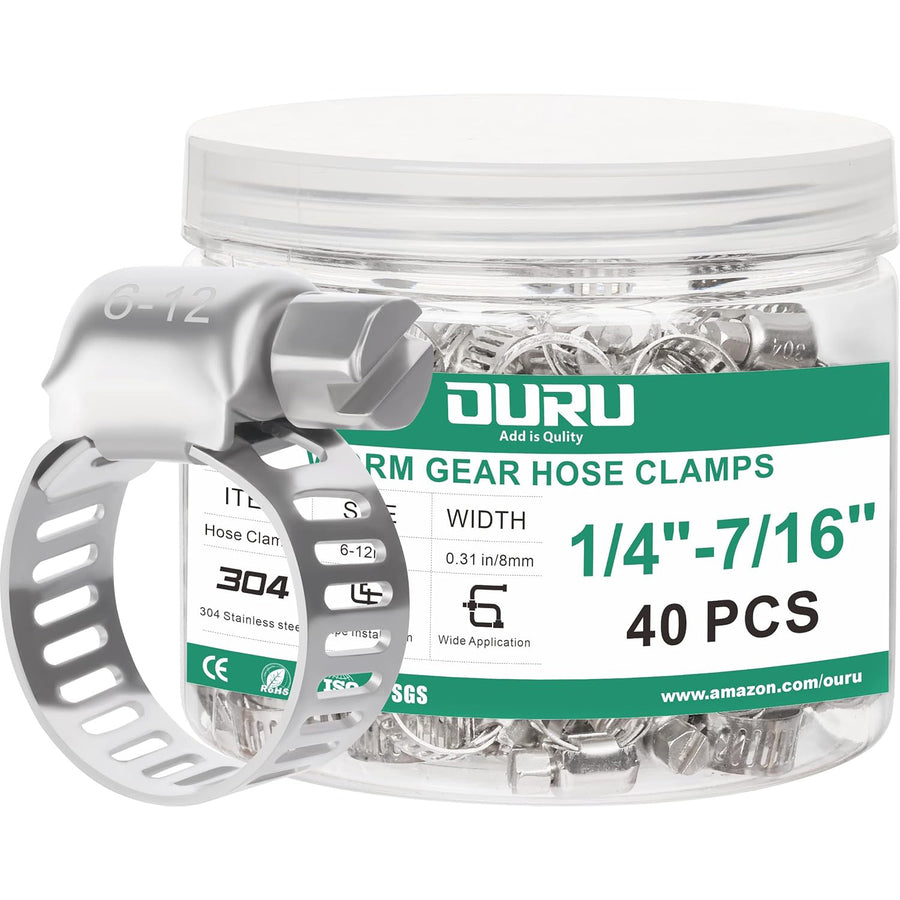
As a final tip, it’s wise to keep an assortment of hose clamps in your toolkit or garage. Having a variety – like an assortment kit that spans multiple diameters – means you’ll always have the right size when you need it, without a last-minute run to the hardware store. The Ouru Hose Clamp Size Kit we mentioned is a great example: it contains dozens of clamps in the most common sizes, all in one box. This ensures that whether a repair calls for a small 1/2 inch pipe clamp (hose clamp for a 1/2″ line) or a couple of hose clamps 2 inch wide for a larger job, you can just reach into your kit and pull out the perfect clamp. It’s like having the convenience of a hardware store selection at your fingertips. Plus, all those clamps are stainless steel, meaning they’ll last and can be reused.
In conclusion, achieving a leak-free seal is easy when you measure twice and clamp once – get the size right, choose the proper type, and tighten appropriately. No more mystery puddles under your car, no more drips under the sink, and no more worry about hoses blowing off. You can tackle your plumbing fixes, automotive tweaks, or marine projects with confidence. A little attention to hose clamp sizing goes a long way to ensure safety and reliability. Now go forth and clamp with confidence, knowing you’ve got the knowledge to select the correct size every time.
Leave a comment