



Tighten for a Secure Seal
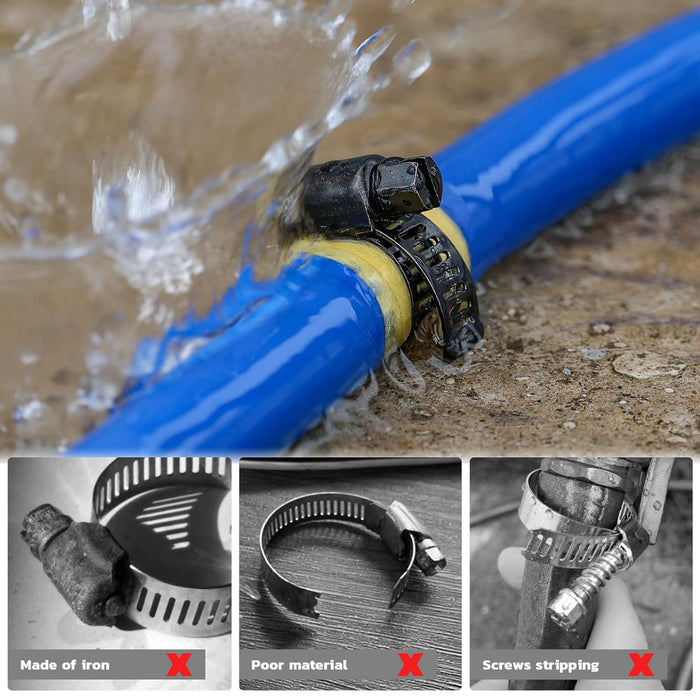
The worm-drive design applies even pressure for a firm, leak-resistant seal
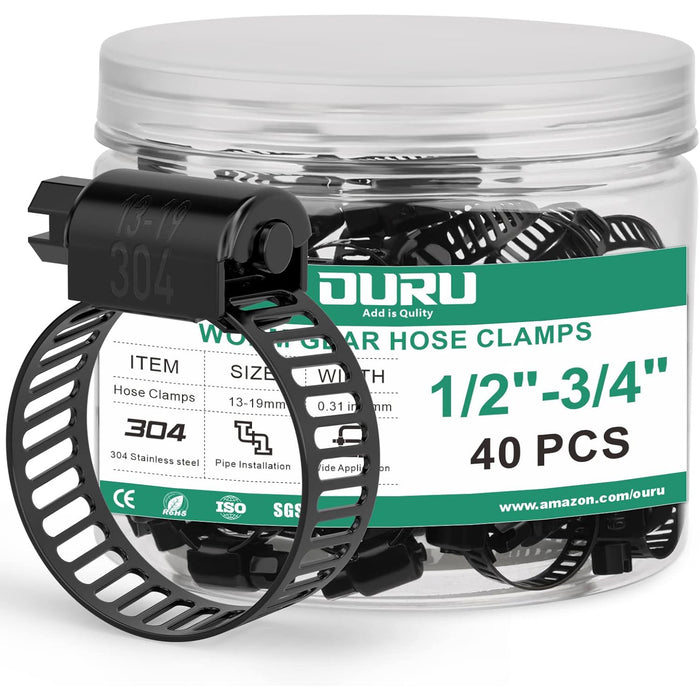
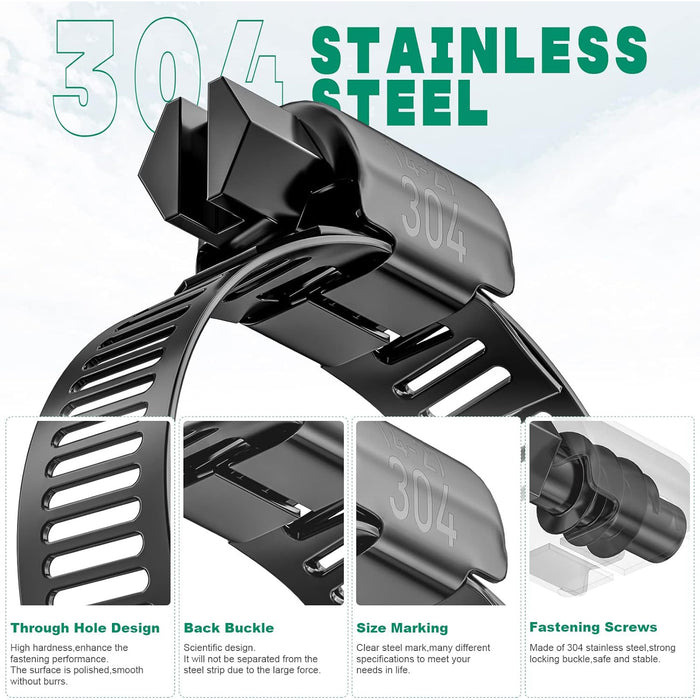
OURU metal hose clamp black housing is black-plated to ensure that does not fade. Made of heavy-duty 304 stainless steel material(includes housing and screws), which is a strong and reliable material. It won't corrode or rust even with long-term use indoors and outdoors
Strong steel band with unique through-hole design, smooth surface without burr, powerful locking force and twisting force, torque of 2.7N.M.It will not strip out or break during the tightening process, effectively solve the problem of hose gas or liquid leakage
Upgraded worm drives device for the metal strip to pass smoothly and tightening more quickly. By deepening and improving the thread, the screws will not loosen,slip or strip out and thereby increase the stability of the product
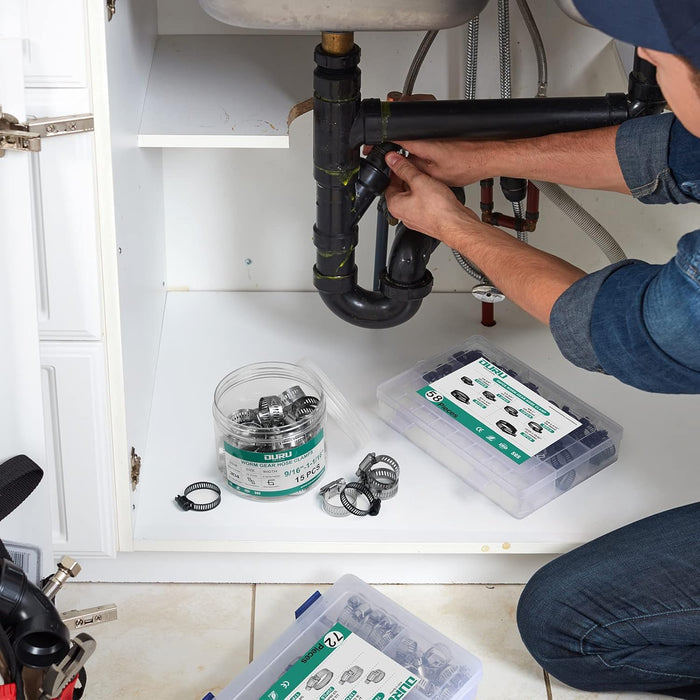
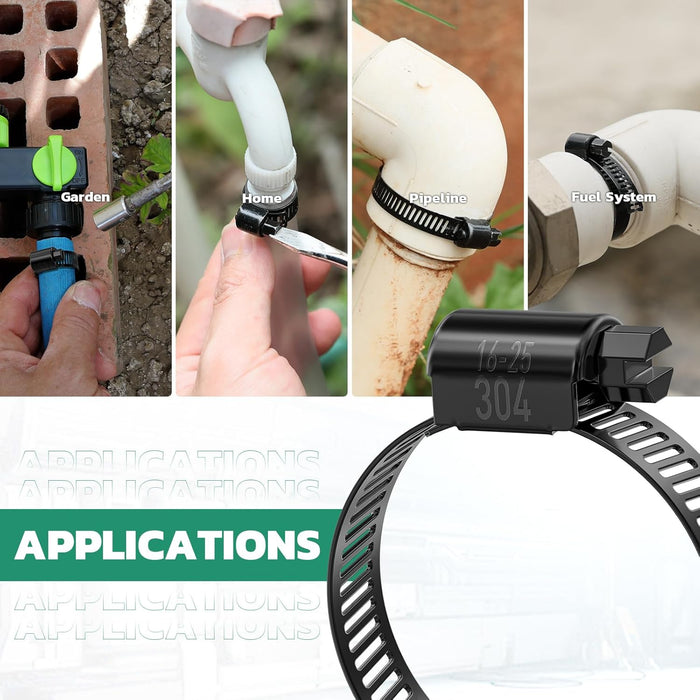
The stainless steel hose clamps also can be used to tight hoses, pipes, fuel lines in home, garden, mechanical, electronic, marine, boat, dryer, vent, radiator and air conditioning, ect. Meet your needs in different applications
The worm-drive design applies even pressure for a firm, leak-resistant seal


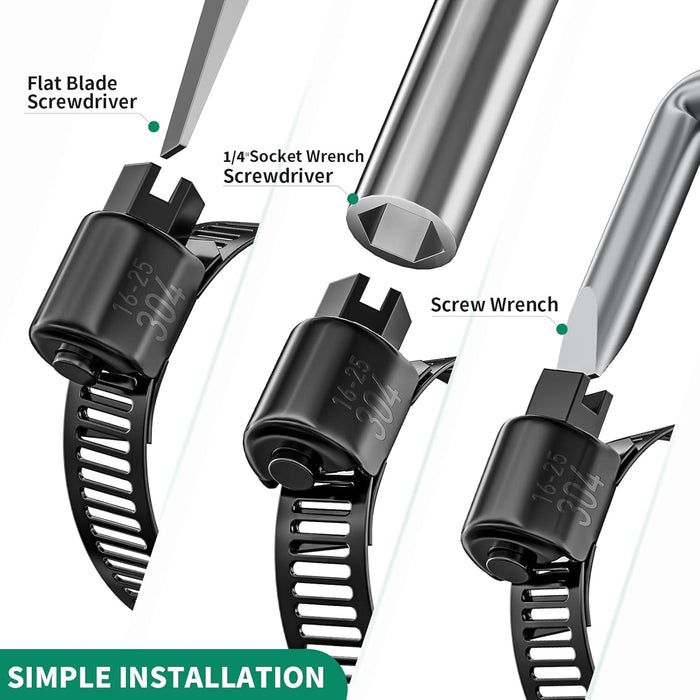
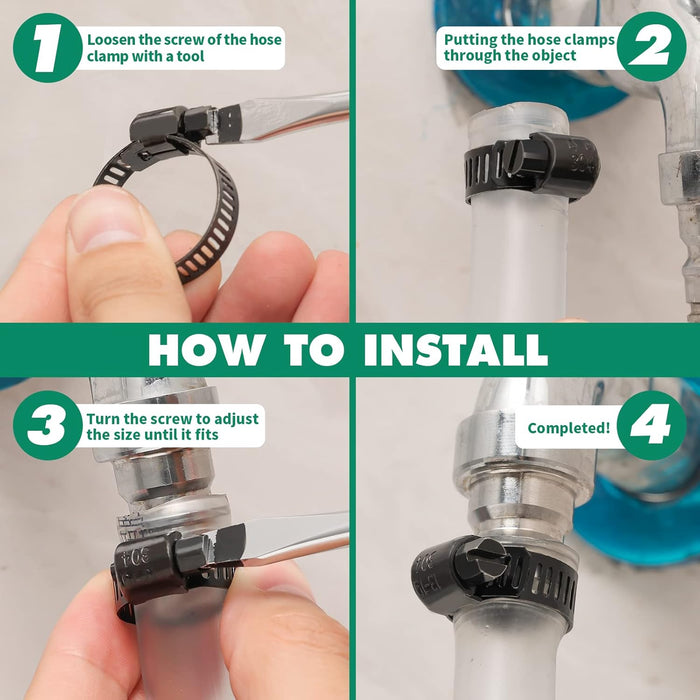
Adjust the clamp with a screwdriver for fast installation, removal, and reuse.

Nicely packaged in a case with over-center latches. These are metric clamps. Instead they are 6 and 7mm drives. It is quite easy to over-tighten and jam these screw clamps. As such, I would not recommend them for any critical application. For general use around the house, they’re just fine. I used them for heater hose lines on one of my cars and they should work just fine
Big-Foot

A nice variety of hose clamps, good quality and a nice case to keep them all organized. The included flat head screwdriver is unnecessary (I tossed it immediately) do your self a favor and use a nut driver or socket with these.
Harrison Jenkins

This is a nice range of hose clamp sizes in a handy container. I have not needed one yet, but they look like decent quality. They appear very similar to clamps I have bought at home improvement store. They are marked 304, which would indicate that they are made of the standard, most common grade of stainless steel. The kit also includes a screwdriver. If you work with plumbing, watergardens, aquariums, etc., this is a really handy set that would be worth having around.
The J

These work good I really like that there stainless steel so there rust resistant. Super easy to use you just turn screw with screwdriver to make the clamp bigger. Then you fit it over what your clamping and tighten it. The steel feels strong and durable. I also like that these come with a clear case.
Kenneth
There are two parts here – the nylon clamp’s range and the stainless clamp’s (which is really about the rubber cushion’s range, since steel itself can endure far more heat).
So practically:
In outdoor environments like solar farms, rooftop cable runs, or industrial facilities, both types work well within expected ambient extremes.
Yes, we offer both assortment kits and bulk pack options. For installers and contractors who need a variety of sizes on hand, we have kits that include multiple clamp sizes in one package. For example, a popular assortment might be a kit of 50 or 80 pieces containing common sizes such as 1/4", 5/16", 3/8", 1/2", 5/8", 3/4", etc., so you’re prepared for different cable diameters. One of our kits has 7 different sizes – e.g. a mix from 1/4" up to 3/4" – with quantities of each, labeled and organized so you can easily grab what fits your cable. These assortment kits are very handy for someone doing a lot of custom wiring (like an automotive electrician or a data cabling installer) who will encounter cables of various thicknesses.
On the other hand, if you know you need a lot of one particular size, we do sell bulk packs (economy packs) of a single size. Typically, our nylon clamps might come in bags of 100, 500, or 1000 pieces for a given size, and our metal cushioned clamps often come in packs of 25, 50, or 100 for a given size. For instance, you can buy a bag of 100 pieces of 1/2" clamps if that’s what your project mainly uses. The larger the pack, usually the better the unit price, which is great for contractors.
We also have some assortment kits for P-clamps (rubber-lined metal clamps) that include multiple sizes. For example, an assortment might have 52 pieces of stainless cushioned clamps in sizes ranging from 1/4" up through 3/4" diameters – those are popular for automotive and marine use where you often need a range. Similarly, we have nylon clamp kits (sometimes 100+ pieces) covering a range of bundle diameters (often from about 3/16" up to 1" in one kit).
In summary, yes, we cater to both needs: mixed-size kits for variety and bulk packs for quantity. Installers can get an assorted set to cover all bases, or stock up on large packs of the exact size they use most.
Cable clamps (whether nylon or metal) provide a more robust and permanent solution than standard zip ties or simple clips in many aspects:
Other points to consider:
In summary, cable clamps provide a stronger, more secure, and maintenance-friendly solution compared to zip ties or basic clips.
Most cable clamps are designed to allow repeated opening and closing as part of normal use – they don’t permanently deform from being used a few times. Here’s what to expect:
In general, a good-quality clamp will not deform or lose its ability to hold just from normal reuse. If you think about it, during initial installation you often have to open the clamp to get the cable in place, then close it to screw it – that’s one cycle right there. They anticipate that sometimes you’ll need to adjust things. For nylon clamps, the material’s elasticity allows that initial flex and subsequent ones. For metal, the clamp often has a bit of a “spring” in its design – when bolted down it’s tight, and when unbolted it opens slightly – that spring characteristic persists through multiple cycles.
One thing to be mindful of: don’t overtighten clamps, especially nylon, because that can cause cracking on the first use, and then obviously reuse would be compromised. Also, when loosening a clamp for maintenance, try not to yank it open unnecessarily – just open enough to get the cable free. This way you’re staying in the elastic range of the material.
From a practical point of view, we have customers in industrial settings who routinely undo clamps to add a new cable to a bundle and then screw them back, and they do this over the years without needing to replace the clamps. If a clamp ever does look fatigued or if the hole gets enlarged from screw wear, they are inexpensive to replace – but that’s rarely needed unless it was abused.
In summary: Yes, cable clamps support repeated opening/closing for maintenance.
The optimal spacing between cable clamps depends on the cable bundle’s weight, orientation, and how rigid the cables are, but there are some general guidelines for a neat and secure installation:
In summary, a good starting point is one clamp per foot of run, and adjust from there. If you see any sag or if the cable is under any strain, add more clamps. In a benign environment (like along an indoor baseboard) you might stretch to 18" spacing and be fine. In a demanding environment (engine bay, industrial machine), you might clamp every few inches as needed.
{"one"=>"Select 2 or 3 items to compare", "other"=>"{{ count }} of 3 items selected"}