Skip to content

Pipe Clamp 304 Stainless Steel - Bottle 8-16 PCS

Original price $12.99 - Original price $12.99
Original price
$12.99
$12.99 - $12.99
Current price $12.99
Availability:
in stock, ready to be shipped
Availability:
in stock, ready to be shipped
Availability:
in stock, ready to be shipped
Availability:
in stock, ready to be shipped
Availability:
in stock, ready to be shipped
Availability:
in stock, ready to be shipped
Kit: 1" 12 PCS
Description

304 Stainless Steel

Premium Material: Crafted from high-quality 304 stainless steel, this pipe clamp offers exceptional resistance to rust, corrosion, and weathering. It maintains structural integrity and a polished look even in harsh, humid, or outdoor environments, ensuring long-lasting performance and reliability

Secure Hold

Durable Rubber Strip: The integrated high-density rubber lining significantly enhances grip to prevent pipes and cables from slipping. It also effectively absorbs vibrations and protects surfaces from abrasion, ensuring a secure and durable hold

Easy installation

The conduit strap clamp features a precise 1/4 inch dual-hole design. Simply drill holes along the marked positions, insert screws, and tighten for a quick and secure installation. Eliminate cumbersome steps and make installation effortless

Wide Application

Suitable for various household and industrial uses, particularly ideal for scenarios requiring vibration damping, noise reduction, and pipeline protection – such as HVAC systems, industrial equipment, marine pipelines, and water supply/drainage systems

Shipping
  • Enjoy free shipping on all orders.
  • Delivery Time: 3-5 business days to The US and Canada. Delivery times may vary depending on your location and carrier conditions.
  • Details
  • Tracking: After your order is shipped, you will receive an email with a tracking number to monitor the delivery status.
  • Need Help? Contact our support team for assistance with shipping or your order.
Returns & Refunds
  • 30-Day Returns
    You may request a return within 30 calendar days of delivery. Items must be unused, in their original condition, and include all original packaging and accessories.
  • Damaged, Defective, or Incorrect Items
    Contact us with your order number and photos. If the issue is due to our error, we will cover reasonable return shipping costs or provide an appropriate replacement.
  • Refunds
    Approved refunds are issued to your original payment method within 5 business days after inspection. Your bank may require additional processing time.
  • To start a return, email support@ourushop.com with your order number and reason for return. Please obtain approval before sending anything back.
  • View Full Return & Refund Policy
Payment Methods
PayPal Visa Mastercard American Express Discover Apple Pay

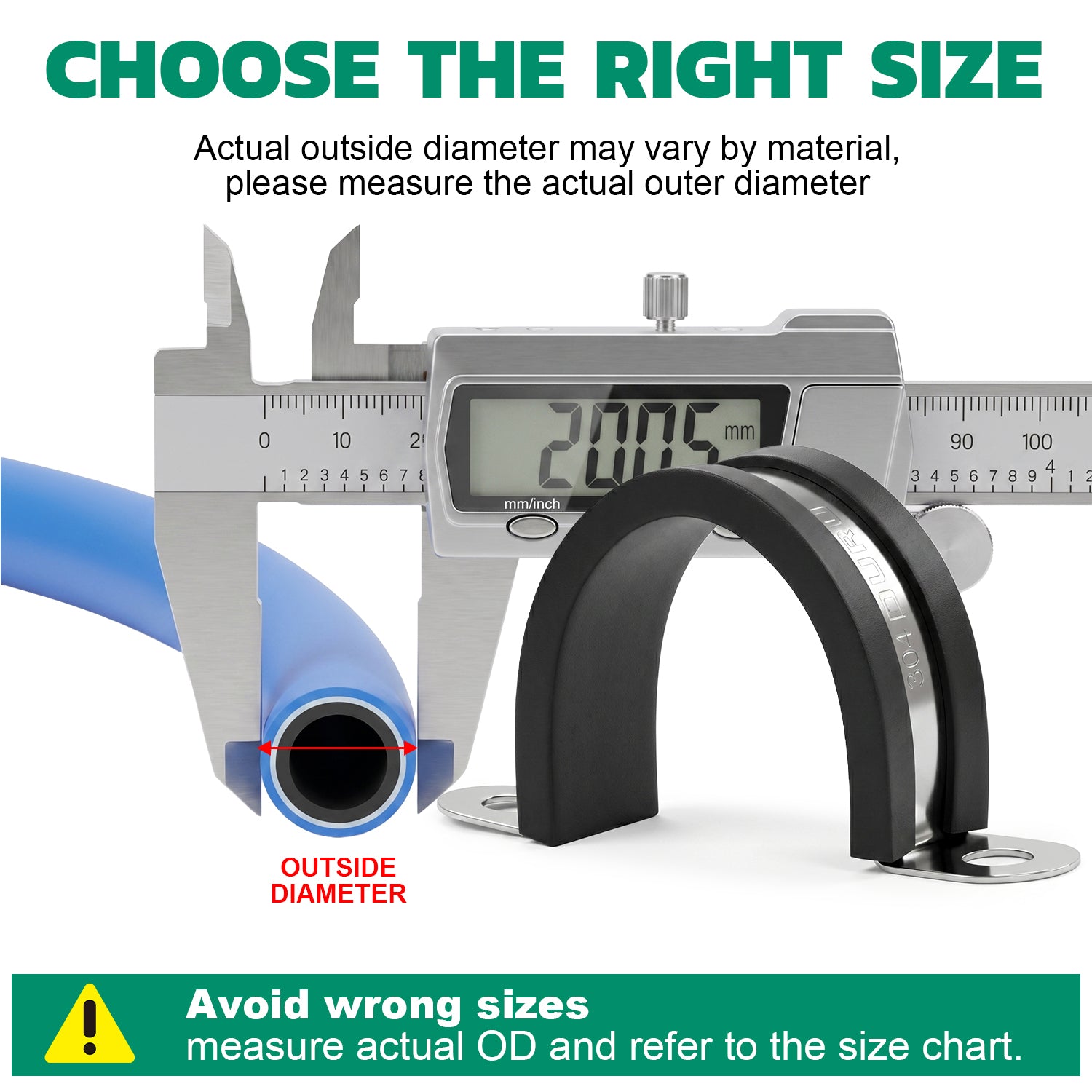
Find Your Clamp Size

Caliper measuring pipe outside diameter
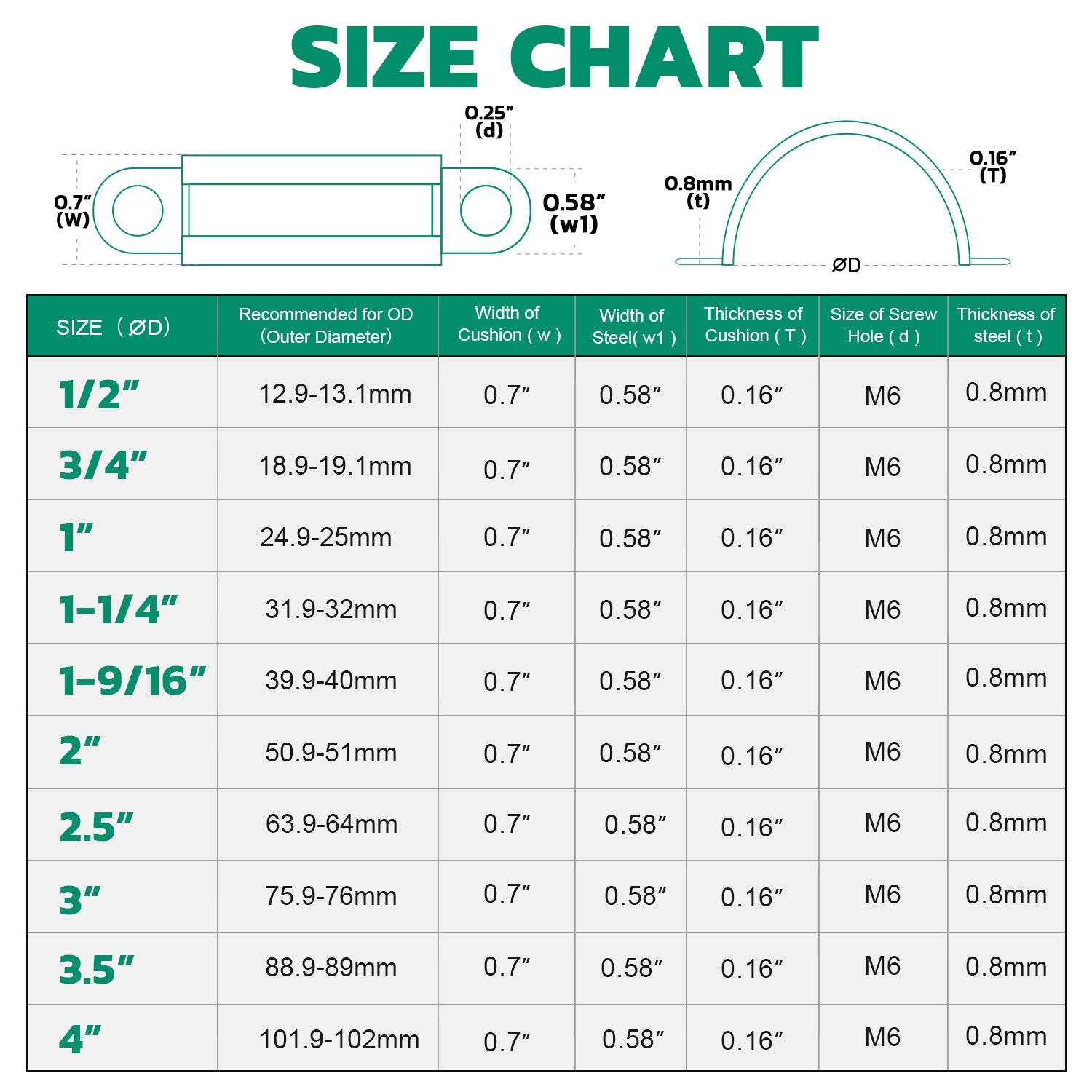
Clamp sizePipe outside diameter
1/2 inch12.9–13.1 mm
3/4 inch18.9–19.1 mm
1 inch24.9–25 mm
1-1/4 inch31.9–32 mm
1-9/16 inch39.9–40 mm
2 inch50.9–51 mm
View all sizes and specifications Pipe clamp size chart from 1/2 inch to 4 inches with outside diameter, cushion width, steel width, thickness and M6 screw hole specifications

Install in Four Steps

  1. 01Mark the mounting position
  2. 02Drill the mounting holes
  3. 03Position the pipe and clamp
  4. 04Tighten suitable fasteners

Choose fasteners suitable for your mounting surface.

304 Stainless Steel for Long-Lasting Protection

304 Stainless Steel for Long-Lasting Protection

Rust & Corrosion Resistant
For humid, outdoor, and demanding environments

Rubber-Lined Grip for Stable, Quiet Support

Rubber-Lined Grip for Stable, Quiet Support

  • Anti-Slip Grip
    Helps keep pipes and cables securely in place
  • Vibration Damping
    Reduces noise, movement, and surface abrasion
Dual-Hole Design for Fast, Secure Installation

Dual-Hole Design for Fast, Secure Installation

Quick & Secure
Easy to position, tighten, and hold firmly

Reliable Support for Pipes, Conduits, and Cables

Reliable Support for Pipes, Conduits, and Cables

  • HVAC · Marine
    Industrial Equipment
  • Plumbing · Electrical
    Indoor and outdoor applications

Trusted by customers Who Know Best

Cushioned pipe, many sizes

The rubberized cushion makes installing these easy, as the rubber allows you to tighten down on the pipe without crushing it. Available in a few sizes, which is nice.

dinosaur mike

These rubber clamps are very good for multiple purposes. Good quality.

Blueboy

These sit perfectly with 2 inch pipe. They are of a decent quality and have no sign of wear and tear.

Michael

These clamps are exactly what I expected. They are solid, the rubber/ plastic material has a little bit of elasticity to conform to the pipe, but not too much give where it won’t hold the pipe. I’d say the material has just enough flexibility to do the job well.

Ben

They appear to be well made and are visually appealing.

Pickles Picks

Free Shipping

On qualifying orders

Warranty Info

See warranty details

Need Help?

Contact our support team

Payment Security

Encrypted payments, trusted providers

FAQ

What is the operating temperature range for nylon vs stainless/rubber-cushioned clamps in outdoor environments?

There are two parts here – the nylon clamp’s range and the stainless clamp’s (which is really about the rubber cushion’s range, since steel itself can endure far more heat).

  • Nylon cable clamps: Typical operating temperature range is about -40 °F to +185 °F (approximately -40 °C to +85 °C). Within this range, the nylon retains good strength. At low temperatures (below -40) nylon can become brittle; at high temperatures (approaching 200 °F) it significantly softens and its tensile strength drops. Some specialized nylon 6/6 formulations or additives can extend the high end a bit (some claim up to 105 °C or 221 °F for short periods), but a safe general guideline is -40 to 85 °C for continuous exposure. So outdoors, a nylon clamp can handle winter freezes and summer heat on a rooftop. Just keep them away from continuous contact with something extremely hot (like engine or exhaust parts above its limit). Also note that UV exposure and heat together over years can age nylon – but UV-stabilized black nylon mitigates that.
  • Stainless steel clamps with rubber cushion: The metal band (stainless steel) is not the limiting factor in normal scenarios – stainless steel can withstand hundreds of degrees (well beyond any environment cables would survive) and remains fine in sub-zero cold. The limiting factor is the cushion liner (and sometimes the screw hardware). Most standard cushioned clamps use a rubber like neoprene or EPDM. A typical rating for neoprene cushions is up to about 212 °F (100 °C) continuously. They can tolerate spikes above that briefly, but beyond ~100 °C the rubber may harden or crack over time. Neoprene and EPDM remain flexible down to around -20 °F (-29 °C) or even lower (some EPDM can go to -50 °F) without losing elasticity, so cold isn’t an issue unless extreme. For example, one manufacturer lists their EPDM-lined clamps at -50 °F to +350 °F as an extreme range, but realistically the cushion might start to degrade if held at 350 °F too long. In general, expect about -30 °C to +100 °C performance from standard cushioned clamps.
    If higher temperature is needed, there are high-temp cushions: e.g., silicone or fluorosilicone cushions that allow use up to 450 °F (232 °C). Those are for engine manifolds, etc. In outdoor environments like a solar installation on a roof, you won’t hit 450 °F, so standard cushions are fine. On the low end, rubber cushions stay okay to very cold temps but could stiffen slightly in arctic conditions (the clamp still works, just the rubber might be less pliable at -40 °C, but it doesn’t fail).

So practically:

  • Nylon clamps: ~-40 to 185 °F (-40 to 85 °C) is a normal safe operating range.
  • Stainless + rubber clamps: -20 to ~212 °F (-30 to 100 °C) for usual neoprene/EPDM cushioned types, and extended to much higher (~450 °F) if using special silicone cushions. Cold tolerance extends further below zero than we typically need (into the -50 °F/C zone).

In outdoor environments like solar farms, rooftop cable runs, or industrial facilities, both types work well within expected ambient extremes.

Do you sell cable clamp assortment kits (mixed sizes) and bulk packs for installers and contractors?

Yes, we offer both assortment kits and bulk pack options. For installers and contractors who need a variety of sizes on hand, we have kits that include multiple clamp sizes in one package. For example, a popular assortment might be a kit of 50 or 80 pieces containing common sizes such as 1/4", 5/16", 3/8", 1/2", 5/8", 3/4", etc., so you’re prepared for different cable diameters. One of our kits has 7 different sizes – e.g. a mix from 1/4" up to 3/4" – with quantities of each, labeled and organized so you can easily grab what fits your cable. These assortment kits are very handy for someone doing a lot of custom wiring (like an automotive electrician or a data cabling installer) who will encounter cables of various thicknesses.

On the other hand, if you know you need a lot of one particular size, we do sell bulk packs (economy packs) of a single size. Typically, our nylon clamps might come in bags of 100, 500, or 1000 pieces for a given size, and our metal cushioned clamps often come in packs of 25, 50, or 100 for a given size. For instance, you can buy a bag of 100 pieces of 1/2" clamps if that’s what your project mainly uses. The larger the pack, usually the better the unit price, which is great for contractors.

We also have some assortment kits for P-clamps (rubber-lined metal clamps) that include multiple sizes. For example, an assortment might have 52 pieces of stainless cushioned clamps in sizes ranging from 1/4" up through 3/4" diameters – those are popular for automotive and marine use where you often need a range. Similarly, we have nylon clamp kits (sometimes 100+ pieces) covering a range of bundle diameters (often from about 3/16" up to 1" in one kit).

In summary, yes, we cater to both needs: mixed-size kits for variety and bulk packs for quantity. Installers can get an assorted set to cover all bases, or stock up on large packs of the exact size they use most.

How do cable clamps compare to zip ties and cable clips for strain relief, vibration control, and reusability?

Cable clamps (whether nylon or metal) provide a more robust and permanent solution than standard zip ties or simple clips in many aspects:

  • Strain Relief: Cable clamps are superior for strain relief because they physically hold the cable to a fixed surface, taking stress off connectors and preventing movement. When you secure a cable with a clamp near a termination, it means any pulling force on the cable won’t transmit to the connector as much. Zip ties, on the other hand, typically just bind cables together or to some anchor point loosely; they don’t grip as firmly over a surface area. Clamps, especially those with a cushion, distribute the holding force and can be tightened just enough to prevent slip without crushing the cable. This makes them ideal for managing heavy cables or those that need a fixed routing to avoid strain. In contrast, a plastic cable clip (like a nail-in clip) does attach to a surface, but usually only covers a small portion of the cable and may not be as secure for heavy loads. For real strain relief (e.g., securing a power cord entering a device or a cable going into a junction box), dedicated clamp-style strain reliefs are often used, or a cable clamp is bolted so the cable can’t pull out.
  • Vibration Control: Here, cushioned cable clamps shine. A rubber-lined P-clamp holds the cable tightly and the rubber absorbs vibrations, preventing the cable from chafing or fatigue due to engine vibration or machinery motion. Even all-nylon clamps, because they encircle the cable, keep it from moving around and can reduce vibration transmission (nylon has some flex as well). Zip ties do not provide much vibration damping – if you tie a cable to a frame with a zip tie, the cable can still move a bit and the tie doesn’t cushion it, so over time the insulation might rub and wear at that point. In high-vibration environments (automotive, aerospace, marine), clamps are preferred for exactly this reason. Cable clips (like those plastic U-clips with a nail or adhesive) also have no cushioning typically, and if the cable oscillates, the clip could eventually cut into the insulation or loosen. Clamps give a firm, padded hold that is ideal for minimizing vibrational impact on the cable run.
  • Reusability: Most cable clamps are reusable, especially the screw-mounted types. You can unscrew a clamp, open it, do maintenance, and screw it back – the clamp will be as good as before (provided you don’t overstrain a plastic clamp by prying it open too far). Many nylon clamps have some flexibility so they can be opened to add/remove cables and then return to shape. Metal clamps can be bent open and closed multiple times without issue in normal use; the steel’s elasticity and the fact you’re usually only flexing it slightly around the bolt hole means it won’t deform or break for many cycles. There are also special adjustable clamps with latches that are explicitly made for reopening – for example, ratcheting cable clamps that lock but have a release tab. Those are very handy for frequent changes. Zip ties by comparison are generally one-time use – once you tighten a zip tie, you have to cut it to remove it (there are reusable zip ties with a little pawl that can release, but they are a niche and even those wear out after a few reuses). So for maintenance scenarios, clamps save you from having to cut and replace ties repeatedly. Cable clips fall somewhere in between: a nailed clip is not really reusable (you’d have to pry out the nail and possibly distort the clip), and an adhesive clip can sometimes be reused (if you didn’t peel off the adhesive and it hasn’t lost stickiness, you could re-position it once or twice). But none are as straightforward as a clamp with a screw – just unscrew, adjust or remove cable, and reattach.

Other points to consider:

  • Strength & durability: Metal clamps in particular can handle much heavier cables or bundles than a single zip tie or plastic clip. Zip ties have a tensile strength rating (e.g., 50 lbs for a typical tie) but in practice, a heavy cable will cause thin ties to dig in or possibly snap under shock load. A steel band clamp can take a lot more stress. Also, plastic zip ties outdoors degrade in UV and can become brittle relatively quickly (a year or two of sun can make them snap) – whereas a UV-resistant nylon clamp or a stainless clamp will last much longer without breaking.
  • Neatness and organization: Zip ties are very good for bundling multiple cables together, but clamps are better for routing cables along surfaces. Often the best practice is to use a combination: for example, bundle a group of wires with ties, then use clamps every so often to secure that bundle to the frame or wall. If using only one method, clamps give a more secure, professional result for fixed routing, while ties are quick for general bundling.
  • Cost and convenience: Zip ties are extremely cheap and fast – that’s why they’re ubiquitous. You can install a bunch of zip ties in seconds and they cost pennies each. Clamps, being more substantial hardware, cost more each and take a bit longer to install (especially screw clamps, since you have to drive a screw for each). So for massive bundles or temporary setups, ties win on speed/cost. But for longevity and quality, clamps win – you might use fewer clamps spaced out, versus many ties.

In summary, cable clamps provide a stronger, more secure, and maintenance-friendly solution compared to zip ties or basic clips.

Do cable clamps support repeated opening/closing for maintenance, and will they deform after reuse?

Most cable clamps are designed to allow repeated opening and closing as part of normal use – they don’t permanently deform from being used a few times. Here’s what to expect:

  • Nylon R-type clamps: These are somewhat flexible. You typically secure them with a screw; when the screw is removed, the clamp opens up (springing back a bit) and you can take the cable out. The nylon has a memory but within elastic limits. Unless you force it way open beyond its normal shape, it will return to its original form. So you can definitely undo a nylon clamp to add or remove cables and then screw it back down. After many cycles (dozens of times), the plastic may start to show whitening or minor stress at the bend, which indicates some fatigue – but under typical maintenance schedules (opening a clamp maybe a handful of times over its life) it’s fine. As long as you don’t bend it backward flat or yank it open unnecessarily wide, it won’t lose its shape. The screw hole area is usually reinforced and can handle multiple screw insertions. It’s a resilient design, meant to be semi-permanent but serviceable.
  • Metal P-clamps: These can be opened by removing the bolt and then flexing the clamp open enough to get the cable out. They are made of springy metal (stainless or aluminum) that can tolerate some bending. Repeated bending back and forth has some limit (any metal will fatigue eventually), but the number of times you’d do this in maintenance is pretty low. In practice, metal cushioned clamps can be reused many times; it’s common in aviation and automotive maintenance to unbolt and rebolt such clamps during servicing. They don’t typically deform – the round shape might open slightly when not bolted, but once you put the screw back, it clamps down to the same diameter. The rubber cushion also helps accommodate any tiny changes. Unless you physically flatten it or pry it way open (which you don’t need to do), it will maintain its shape and clamping force. One suggestion: when reusing, ensure the clamp still has a good curvature – if it’s been pried overly wide, you can gently squeeze it back a bit. But normally, removing the screw and maybe holding the clamp ends apart to slip the cable out won’t hurt it.
  • Special re-openable clamps: We also have clamps explicitly made for repeated access – for example, adjustable ratchet clamps with a release tab, or clamps with a latch. These are by design meant to be opened and closed many times with no degradation. If your application involves frequent re-routing or temporary cables, these types are ideal. They won’t deform at all because you’re not bending the material, you’re using a built-in mechanism.

In general, a good-quality clamp will not deform or lose its ability to hold just from normal reuse. If you think about it, during initial installation you often have to open the clamp to get the cable in place, then close it to screw it – that’s one cycle right there. They anticipate that sometimes you’ll need to adjust things. For nylon clamps, the material’s elasticity allows that initial flex and subsequent ones. For metal, the clamp often has a bit of a “spring” in its design – when bolted down it’s tight, and when unbolted it opens slightly – that spring characteristic persists through multiple cycles.

One thing to be mindful of: don’t overtighten clamps, especially nylon, because that can cause cracking on the first use, and then obviously reuse would be compromised. Also, when loosening a clamp for maintenance, try not to yank it open unnecessarily – just open enough to get the cable free. This way you’re staying in the elastic range of the material.

From a practical point of view, we have customers in industrial settings who routinely undo clamps to add a new cable to a bundle and then screw them back, and they do this over the years without needing to replace the clamps. If a clamp ever does look fatigued or if the hole gets enlarged from screw wear, they are inexpensive to replace – but that’s rarely needed unless it was abused.

In summary: Yes, cable clamps support repeated opening/closing for maintenance.

What’s the recommended spacing between cable clamps along a run to meet tidy cable‑management best practices?

The optimal spacing between cable clamps depends on the cable bundle’s weight, orientation, and how rigid the cables are, but there are some general guidelines for a neat and secure installation:

  • A common rule of thumb for horizontal runs (e.g., along a wall or inside an enclosure) is to place clamps about 12 to 18 inches apart for standard cables. This spacing keeps the cable supported so it doesn’t sag noticeably between clamps. For example, in residential wiring, you might strap a cable every 16 inches or so on a joist (which conveniently aligns with stud spacing in many cases).
  • In high-vibration or critical installations, you should use closer spacing. For instance, in industrial or automotive environments, clamps might be spaced every 6 to 8 inches or even closer if the cable is heavy or if maintaining a very tight routing is important. Closer spacing prevents the cable from moving and flexing, which is crucial in vibrations – the cable essentially gets continuous support.
  • For very lightweight cables (like a few small signal wires), you could go toward the higher end of spacing (15–18 inches) since sagging won’t be an issue and they’re not likely to pull themselves free. For heavier cables or bundles, tighter spacing (maybe 6–12 inches) ensures the weight is distributed.
  • Vertical runs (cables going up/down): Here, gravity is pulling down, so you may need tighter spacing at the top to ensure the cable doesn’t start slipping down or putting a lot of load on one clamp. Often the top of a vertical run is fixed very securely, and then you might do every 12 inches down the run. If the cables are heavy (like big power cables), you might even clamp every 6 inches in vertical sections because each clamp is holding the weight of the cable section beneath it.
  • NEC (National Electrical Code) and other standards sometimes specify minimum support intervals. For instance, non-metallic electrical cable in building wiring must be supported within 12 inches of an electrical box and at intervals not exceeding 4.5 feet. That’s for safety (to ensure cables are supported). But for “tidy management” beyond code minimum, we generally go much closer spacing than the code max. So while you could go up to 4 feet between supports per code in some scenarios, it wouldn’t look very tidy or keep the cable straight in most cases. Thus, something like 1–2 feet spacing is a more aesthetic and practical approach for neatness.

In summary, a good starting point is one clamp per foot of run, and adjust from there. If you see any sag or if the cable is under any strain, add more clamps. In a benign environment (like along an indoor baseboard) you might stretch to 18" spacing and be fine. In a demanding environment (engine bay, industrial machine), you might clamp every few inches as needed.

Compare products

{"one"=>"Select 2 or 3 items to compare", "other"=>"{{ count }} of 3 items selected"}

Select first item to compare

Select second item to compare

Select third item to compare

Compare