

PEX Crimp Tool vs Clamp Tool: Check Ring and Jaw Compatibility Before You Buy
THE SHORT ANSWER
No—unless the tool manufacturer explicitly says the tool is designed for both connection systems, you should not use a copper-ring PEX crimp tool on stainless-steel PEX clamps, or a PEX clamp tool on copper crimp rings. The two tools apply force in different places. A copper-ring crimper surrounds and compresses the crimp ring, while a cinch or clamp tool closes the raised ear on a stainless-steel clamp. SharkBite’s manufacturer instructions show the two connection methods using separate tools and separate closing procedures.
This distinction matters when shopping because “PEX crimper” can be used loosely in product naming. The safer buying rule is simple: identify the connection system and ring first, then choose the tool that is documented for that ring and size. Do not assume compatibility because both products say PEX, because the nominal pipe size matches, or because the fastener physically fits between the jaws. ASTM likewise treats these as defined component systems rather than generic combinations of pipe, ring and tool.
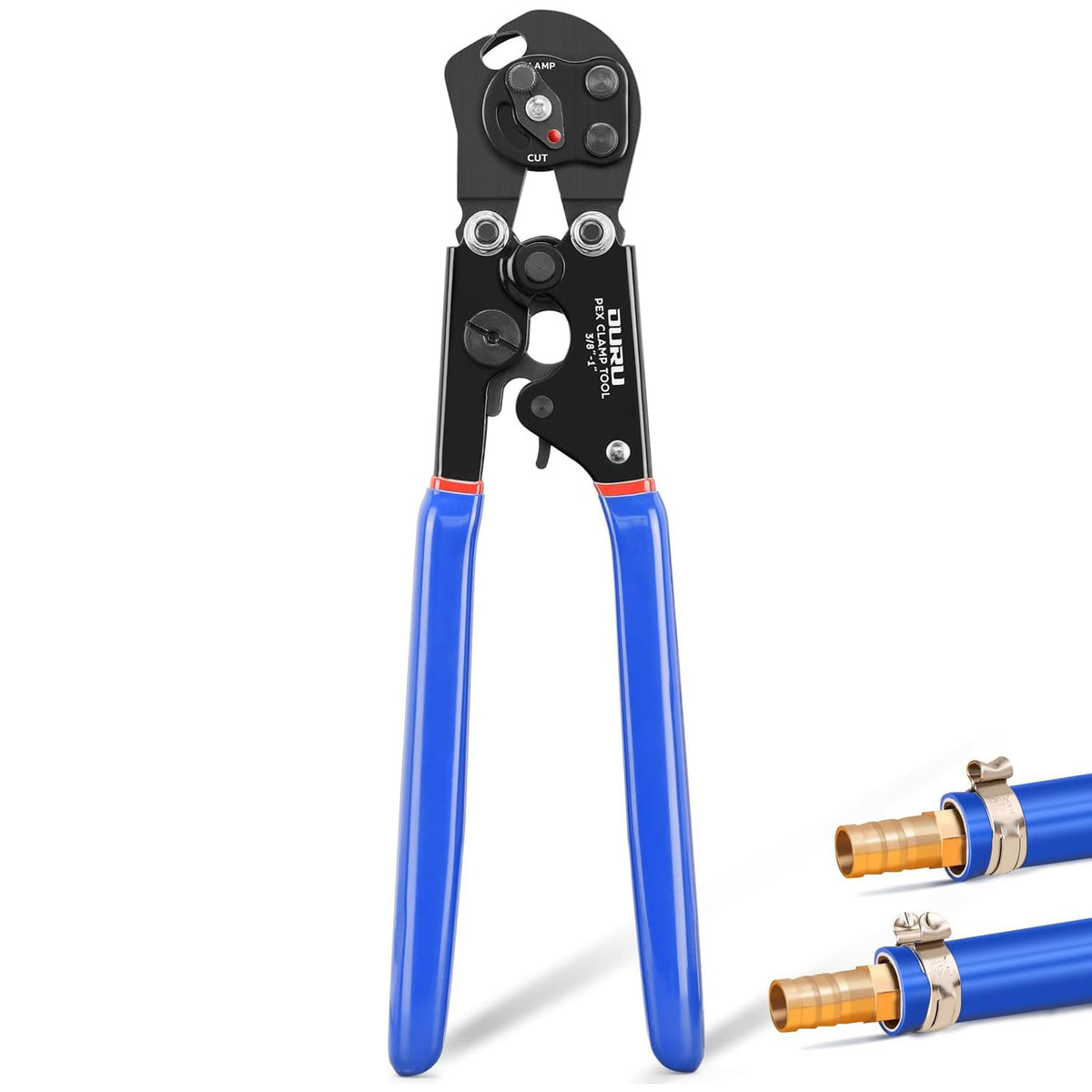
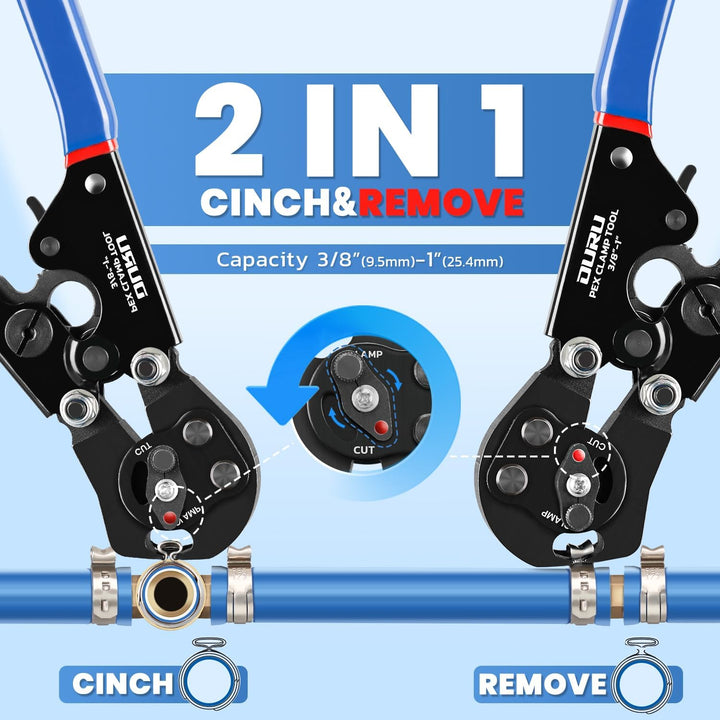
For Ouru shoppers, there is an especially important naming detail. The Ouru 2-in-1 Ratchet PEX tool is documented as a cinch-and-removal tool for stainless-steel clamps from 3/8 inch through 1 inch. In this product, “2-in-1” means cinching plus clamp removal; it does not mean copper crimping plus stainless-clamp cinching. Ouru lists a separate PEX Crimping Tool for Copper Rings for 1/2-inch and 3/4-inch copper crimp rings.
Working with compatible stainless-steel cinch clamps? The Ouru 2-in-1 PEX Cinch & Removal Tool supports the documented 3/8-inch to 1-inch clamp range. Its two functions are clamp installation and removal—not copper-ring crimping.

PEX Crimp vs Cinch: What Actually Changes?

A PEX connection is a system, not just a pipe and a pair of pliers. Before comparing a PEX crimp tool vs clamp tool, separate the three connection approaches that buyers commonly confuse.
Copper crimp rings: a continuous band
With a copper crimp-ring connection, a continuous copper ring is placed over the tubing and the tubing is pushed over a compatible insert fitting. A size-matched crimping jaw closes around the ring. In SharkBite’s documented crimp system, the crimper is placed over the crimp ring and the finished ring is checked with the specified Go/No-Go gauge. ASTM’s current standards index lists F1807 for metal insert fittings utilizing copper crimp rings or alternate stainless-steel clamps, and F2159 for plastic insert fittings utilizing copper crimp rings or alternate stainless-steel clamps.
Stainless cinch clamps: a raised ear
With a stainless-steel cinch or clamp connection, the fastener has a raised ear or tab. A compatible clamp tool engages that raised section and closes it. SharkBite’s installation guide, for example, instructs installers to place the clamp-tool jaws over the raised tabs and then use the inspection method specified for that clamp system. ASTM F2098 covers stainless-steel clamps for securing compatible PEX or PE-RT tubing to metal or plastic insert fittings; importantly, ASTM describes performance testing on the complete fitting-clamp-tubing assembly, not on the clamp in isolation.
Using stainless-steel cinch clamps?
Match your ring type and clamp size before choosing the Ouru 2-in-1 tool.
View Cinch & Removal Tool →Expansion: a separate connection system
Expansion is a third system, not another version of crimping. The current ASTM standards index lists F1960 for cold-expansion fittings with PEX reinforcing rings. Uponor’s ProPEX system, for example, uses ASTM F1960/CAN/CSA B137.5 cold-expansion connections and specified expansion tools and heads. A copper crimper or stainless-clamp cinch tool is not a substitute for that system’s expansion equipment.
Here is the buying distinction at a glance:
| Connection system | Fastener to identify | How the tool engages it | Ouru product to review |
|---|---|---|---|
| Copper crimp | Continuous copper crimp ring | Size-matched jaw surrounds/compresses the ring | Ouru PEX Crimping Tool for Copper Rings, documented for 1/2" and 3/4" rings |
| Stainless cinch/clamp | Stainless clamp with raised ear | Clamp jaws close the raised ear | Ouru 2-in-1 Ratchet PEX Cinch & Removal Tool, documented for 3/8"–1" clamps |
| Cold expansion | PEX reinforcing ring + expansion fitting | Expander head expands tubing and ring | A system-approved expansion tool; neither Ouru tool above is documented as an expansion tool |
These distinctions are reflected in Ouru’s own product pages and in manufacturer installation documentation from SharkBite and Uponor.
The key point for PEX tool compatibility is that a fitting can sometimes be approved for more than one fastening method without making the tools interchangeable. For example, SharkBite lists certain insert fittings that connect with either compatible copper crimp rings or stainless-steel clamp rings. ASTM F1807 and F2159 likewise recognize copper crimp rings and alternate stainless-steel clamps within their respective insert-fitting scopes. Each fastening method still requires its specified installation tool and procedure.
A 1/2-inch label also does not prove tool compatibility. A 1/2-inch copper crimp ring and a 1/2-inch stainless cinch clamp are different fasteners with different closure geometry. One is compressed by a crimping jaw around the ring; the other is closed at its ear by a clamp tool. The manufacturer procedures visibly show this difference.
The same caution applies to PEX-A, PEX-B and PEX-C labels. Those labels describe how the tubing is manufactured; they do not, by themselves, tell you which connection tool is approved. Within SharkBite’s own documented system, crimp-type connections are offered for multiple PEX types, while expansion has separate tubing and fitting requirements. Ouru’s own FAQ similarly warns that PEX-A does not automatically mean expansion-only and that tubing, fitting and joining method must be confirmed together.
That is why a tool that can physically squeeze a ring is not automatically compatible. Correct jaw geometry, size range, closing mechanism and the system-specific inspection method still matter. ASTM F2098’s treatment of the stainless clamp connection as a complete assembly reinforces the same principle: you cannot establish compatibility from the ring alone.
How to Choose the Right PEX Tool Before You Buy

Identify the existing connection
Start with the connection already in front of you. If you are repairing an existing line, identify the fastener before ordering a tool. A continuous copper ring points you toward a copper-crimp system. A stainless band with a distinct raised ear points you toward a cinch/clamp system. A reinforcing ring used with a cold-expansion fitting belongs to a separate expansion system. When the connection cannot be confidently identified, find the tubing and fitting markings and consult the applicable manufacturer documentation rather than guessing from appearance alone.
One tool. Cinch and removal.
See how the two functions work and check the supported 3/8-inch to 1-inch clamp range.
Explore the 2-in-1 Tool →Confirm the fitting system
Next, identify the fitting system. Current ASTM listings distinguish F1807 metal insert fittings, F2159 plastic insert fittings, F2098 stainless clamps and F1960 cold-expansion fittings. These standards describe different components and joining systems; they are not permission to combine any pipe, ring, fitting and tool that happen to share a nominal size.
Match the tool and nominal size
Then match the tool’s documented size range. The Ouru 2-in-1 cinch-and-removal tool lists a 3/8-inch to 1-inch clamp range, while the separate Ouru copper crimp tool is documented for 1/2-inch and 3/4-inch copper crimp rings with a two-size jaw design. This is a practical example of why “multi-size” should not be confused with “multi-system.”
If you choose the copper-ring route, Ouru also lists PEX copper crimp rings, while its stainless product range includes PEX cinch/clamp rings. The stainless product page describes a 304 stainless, single-ear design and specifically calls for a compatible PEX cinch clamp tool. The copper-ring page calls for a compatible PEX crimp tool.
Check the finished connection
Also verify how the finished connection is supposed to be checked. In SharkBite’s copper-crimp procedure, the finished copper ring is checked with the specified Go/No-Go gauge. In its clamp procedure, the clamp tool closes the raised ear and the finished clamp is inspected using that system’s clamp-specific method. Do not automatically transfer the copper-ring Go/No-Go procedure to every stainless clamp system, and do not treat a ratchet release, a hand pull or “it is not leaking right now” as universal proof of a compliant joint.
Check the fit before you start.
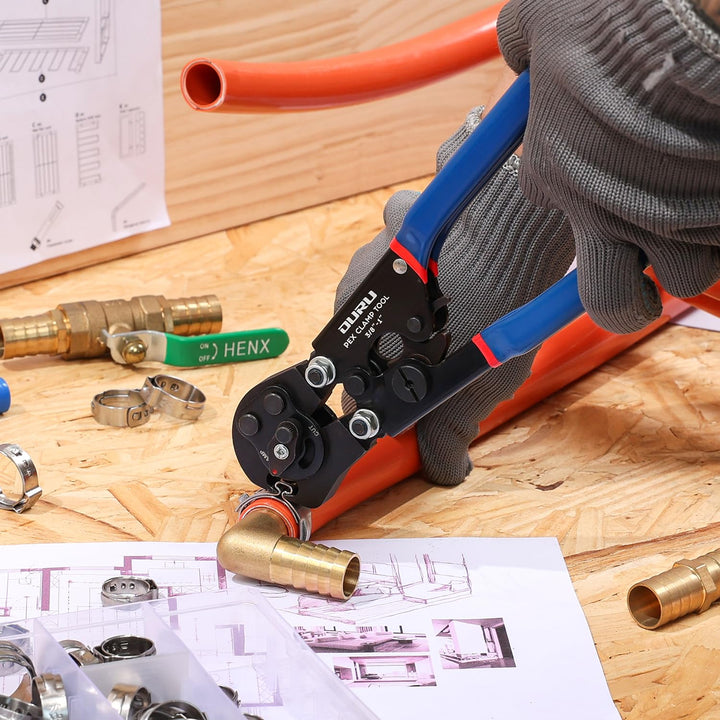
Review the tool details and confirm compatibility and working clearance for your project.
Check Tool Details →Check jaw access and handle travel
Finally, consider working clearance. A copper crimp jaw must surround the ring, whereas a cinch tool engages the clamp ear. Ouru notes that this geometry can make a cinch tool easier to position in some confined spaces, but it does not guarantee access: the jaws still have to seat correctly and the handles must complete their required movement.
Before checkout, answer these seven questions:
- What fastener does my connection actually use—copper crimp ring, stainless cinch clamp or expansion ring?
- Does the tubing manufacturer permit this joining method?
- Is the fitting designed for this ring or clamp system?
- Does the tool explicitly support this fastener type and nominal size?
- What calibration, gauge or completion check does the specific system require?
- Can the jaws seat correctly and the handles complete their full stroke in the installation area?
- For potable-water or concealed work, are the components approved for the application and acceptable under applicable local requirements?
Manufacturer documentation supports treating these as system-level questions rather than choosing a tool from pipe size alone. Uponor, for example, explicitly directs installers to follow product instructions and local codes, while SharkBite’s Canadian product documentation lists application-specific ASTM, CSA and NSF/ANSI/CAN approvals for individual fittings.
For a first PEX project, choose the connection system before the kit. Buying the largest assortment first can leave you with rings that do not match the selected tool or fitting. If your planned system uses compatible stainless cinch clamps, review the Ouru 2-in-1 Ratchet PEX Cinch & Removal Tool and confirm that your clamp sizes fall inside its stated 3/8-inch to 1-inch range. If your planned system uses 1/2-inch or 3/4-inch copper rings, review the Ouru copper-ring crimping tool instead.
For an existing PEX repair, identifying and matching the existing system is the safest starting point. Before removing a connection, isolate the water supply and depressurize the line. Do not assume a removed clamp can simply be installed again, and do not assume tubing or fittings can be reused unless the applicable manufacturer permits reuse and the component remains suitable. Ouru’s own FAQ directs users to shut off and depressurize the supply before clamp removal and to inspect tubing, fitting, insertion and clamp condition when troubleshooting a connection.
For a tight-space installation, do not decide between PEX crimp vs cinch from tool length alone. Mock up the actual jaw position and handle travel. The single-ear clamp geometry may make access easier in some locations, but a partial or angled closure is not an acceptable substitute for completing the connection using the system-approved procedure.
And when buying replacement rings, avoid searching only for “1/2-inch PEX ring.” First determine whether the existing connection uses a copper crimp ring, stainless cinch clamp or expansion reinforcing ring. Nominal size is only one compatibility check, not the entire compatibility decision.
Can You Use a Crimp Tool on PEX Clamps?
For the common systems discussed here, no. Use a copper-ring PEX crimp tool for compatible copper crimp rings and a PEX clamp/cinch tool for compatible stainless-steel ear clamps unless the tool manufacturer explicitly documents the tool for both functions. A copper-ring crimper compresses the ring around its circumference; a clamp tool closes the raised ear. SharkBite’s official instructions show these as distinct tools and distinct procedures.
The same answer applies in reverse. Do not use an ear-clamp tool on a copper crimp ring simply because you can position the ring between its jaws. “It fits” is not an installation specification. Component dimensions, jaw geometry and verification requirements still have to match the documented connection system.
The Ouru product naming makes this point especially important. The current 2-in-1 Ratchet PEX product is documented as a cinch-and-removal tool, not a copper-crimp-and-cinch combination tool. For copper crimp rings, Ouru provides a separate two-size copper-ring crimper. Check your ring type first, and the correct product choice becomes much clearer.
Before working on an existing water line, isolate and depressurize it. Follow the tubing, fitting, ring and tool manufacturers’ instructions for placement, calibration, inspection and system testing. For potable-water systems, concealed installations or work subject to inspection, also check applicable product listings and local plumbing requirements. Uponor’s North American installation documentation specifically directs installers to follow local codes in addition to manufacturer requirements.
Ready to choose? If your project uses compatible stainless-steel cinch clamps, review the Ouru 2-in-1 Ratchet PEX Cinch & Removal Tool and verify the clamp size before buying. If your system uses copper crimp rings, compare the Ouru PEX Crimping Tool for Copper Rings, Ouru copper crimp rings, and the fitting documentation instead. Ouru’s PEX-B coupling range, for example, is offered in 1/2-inch and 3/4-inch sizes and is marketed for compatible crimp/clamp-style connections, but the complete assembly still needs to be checked rather than assuming universal compatibility from the fitting alone.
The correct buying sequence is:
connection system → ring or clamp → fitting → nominal size → compatible tool.
Not tool first.
FIND YOUR MATCH
Choose the tool for your ring
Choose the kit for your project.
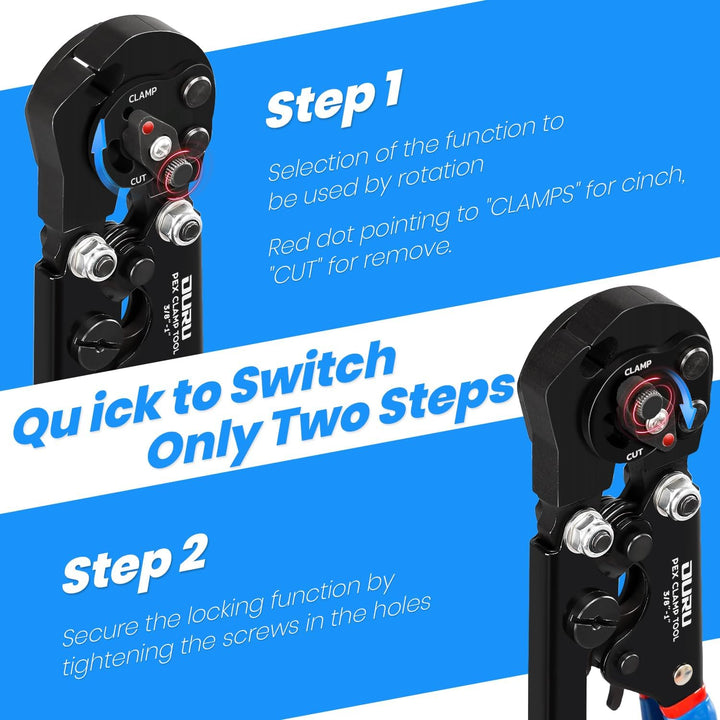
Compare the available options and confirm which tools and clamps are included.
View Tool & Kit Options →Copper crimp rings
For compatible 1/2-inch and 3/4-inch copper crimp rings. Confirm the fitting system before purchase.
View copper-ring crimper →Stainless cinch clamps
Cinch and removal functions for compatible 3/8-inch to 1-inch stainless clamps. Not a copper-ring crimper.
View cinch & removal tool →
Leave a comment